 Lingua
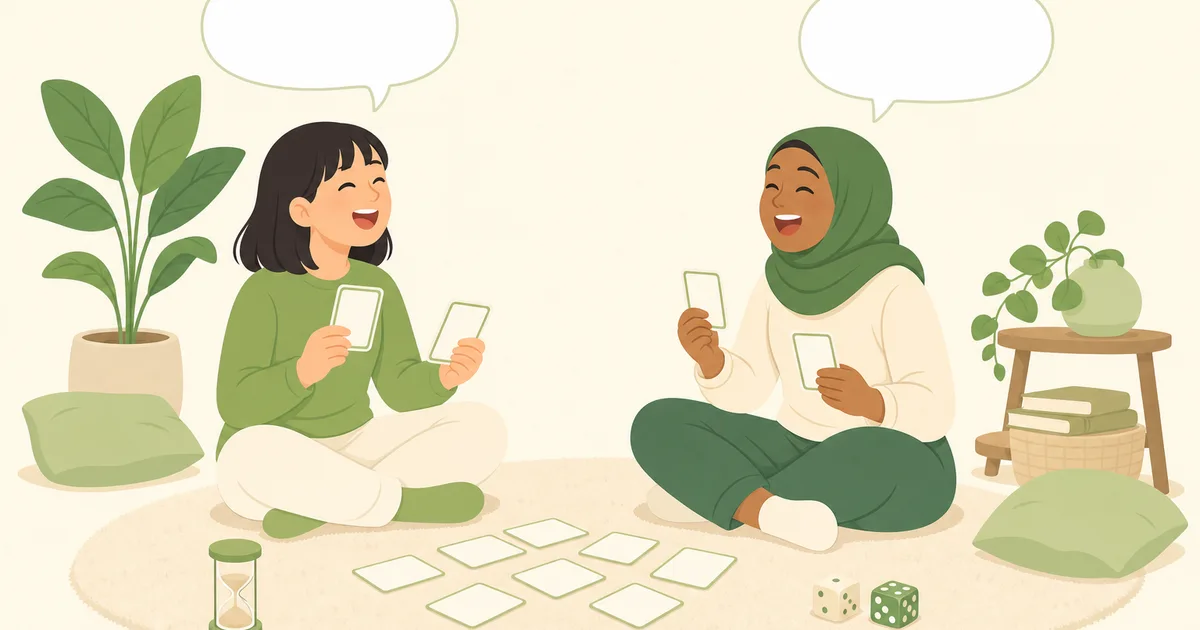
You can learn a language by playing, and for many people it is the only way daily practice survives past the third week. The catch is that most games feel educational without teaching much: you recognise words you already half know, you laugh, you forget. A game teaches when it makes you pull the language out of your own head, say it aloud and meet the same words again on another day. Below are the formats that pass that test, a fifteen-minute daily routine, and the mistakes that turn play into a pleasant waste of time.
Key points
- A useful language game makes you produce the language rather than just recognise it, makes you say it aloud, and brings the same words back over several days.
- The best games need no equipment: describing a word without saying it, twenty questions, word chains and category races work at almost any level.
- Fifteen minutes is enough when it has a shape: a two-minute warm-up, ten minutes of one game, three minutes on the words you missed.
What makes a game teach
Before you pick a game, put it through four questions.
- Do I have to produce the language? Choosing the right answer out of four is recognition. Typing it, saying it or explaining it is recall, and recall is what builds memory (why testing yourself beats rereading).
- Do I speak? A game played in silence trains your eyes. Say every answer aloud, even when the game does not ask you to.
- Do the words come back? One evening with a word is a meeting; a week of evenings is a memory. Reuse yesterday's words in today's game, which is the principle behind spaced repetition.
- Is it at my level? You should follow most of what is going on. A game in which you understand a third is noise.
A game that scores four out of four is study in disguise. A game that scores zero is just fun, which is fine too, but count it as a break.
Word games for two, no equipment
These work at a kitchen table, on a walk or on a video call, with a partner, a friend or a tutor.
- Describe it. One person describes a word in the target language without saying it, the other guesses. At A2, "it is an animal, it is big, it is grey" is a perfectly good round. This is the single best game for speaking: it forces you to talk around the words you do not have, which is exactly what real conversation asks of you.
- Twenty questions. Think of a thing; the other person asks yes-or-no questions. It drills question forms, the grammar beginners avoid.
- Word chain. Each word starts with the last letter of the one before. Fast, simple, and an honest test of how much vocabulary you can actually reach.
- Categories against the clock. Pick a letter and a topic and name as many words as you can in sixty seconds: food, animals, things in the kitchen. The word themes on our site are ready-made category lists with audio.
- Translation ping-pong. One says a word in your shared language, the other answers in the target language as fast as possible. Swap after ten.
- I spy. Pure beginner fun – "I spy something blue" – that forces colours, shapes and the words for the room you are sitting in.
Board games, cards and homemade decks
You do not need special products. Any party game built on talking becomes a language game the moment you play it in the target language, and picture-based storytelling games are especially good because the cards carry no text to read off.
Simpler still, make a deck. Write twenty words on cards with a picture or your native word on the back, then play memory with them, or a version of Go Fish in which you have to ask for a card with a full sentence. The ten minutes spent making the deck are part of the learning.
Video games in the target language
Switching the language of a game you play anyway is one of the most painless kinds of immersion. A few rules make it pay:
- Choose slow games with plenty of text. Role-playing and adventure games, puzzle games, farming and life simulations, visual novels. Fast shooters teach you "reload" and little else.
- Replay a game you know. If you already know the story, context carries you through the sentences you cannot parse yet.
- Turn on subtitles in the same language. Hearing and reading the same line is the principle behind learning with films.
- Keep a notebook nearby. When a line stops you, write down the sentence, not only the word, and look at it again the next day.
- Use voice chat. Cooperative games with speakers of the language are a low-pressure way to talk: the exchanges are short, practical and repetitive.
Role-play and quizzes
Role-play is speaking practice with a script you write yourselves: ordering at a café, checking into a hotel, returning a broken phone, meeting your partner's parents. Play each scene twice, swapping roles, and on the second round the shop assistant adds one surprise. It feels silly for about a minute, and then it is the closest thing to a real conversation you can rehearse.
Quizzes turn your vocabulary into a contest. Quiz each other on ten words from this week, one point per answer said aloud and a bonus for a full sentence. Keep the score in a notebook: watching the number climb is half the fun.
A 15-minute daily plan
| Minutes | What you do | Why |
|---|---|---|
| 0–2 | Warm-up: translation ping-pong with yesterday's words | Fresh words recalled at the right moment |
| 2–12 | One main game, a different one each day | Speaking and recall under light pressure |
| 12–15 | Write down the three to five words you missed and say each in a sentence | Turns the game into tomorrow's review |
Rotate the main game across the week: describe it on Monday, role-play on Tuesday, twenty questions on Wednesday, a video game on Thursday, a quiz on Friday, a board game at the weekend. One rule holds every day: what you missed today opens tomorrow's game.
Playing at your level
- A0–A1. Numbers, colours, I spy, memory with picture cards, yes-or-no games. Short answers and a lot of repetition.
- A2–B1. Describe it, twenty questions, role-plays of everyday situations, word chains. You start building sentences against the clock.
- B1 and above. Video games with dialogue, storytelling games, debates on silly questions, role-plays with complications. The aim moves from words to fluency.
Common mistakes
- Running the game in your own language. Rules, jokes and arguments in your shared language eat half the session. Agree on the phrases you need – "your turn", "I don't know", "say it again" – and use them in the target language.
- Only recognition games. Multiple choice forever feels like progress and stalls the moment you need to speak.
- Games that are too hard. If you understand a third, lower the level, slow down or pick another game.
- No review afterwards. The three minutes after the game are where the learning is kept.
- A contest the weaker player always loses. Give a handicap: more time, a hint, double points. Nobody keeps playing a game they cannot win.
LinguaPair as one of the options
If you would like the games ready-made, LinguaPair has real-time games for two built from the words you have saved and from an everyday word bank: a translation duel, a vocabulary race, a word scramble, true or false, and two team games in which you score together. Each round is thirty seconds of recall, and without a partner you can play against Robo, the app's bot. The games come with Premium; the A0 and A1 courses, the vocabulary trainer, the streak and the XP are free. How the points, the streak and the league are built, and how to stop them turning into a chase, is covered in gamification in language learning. And if you play with your partner, learning a language with your partner has the rules that keep it fun for both of you.
Playing is not a shortcut. It is a way of doing the repetition that learning needs, in a form you actually want to come back to.