 Lingua
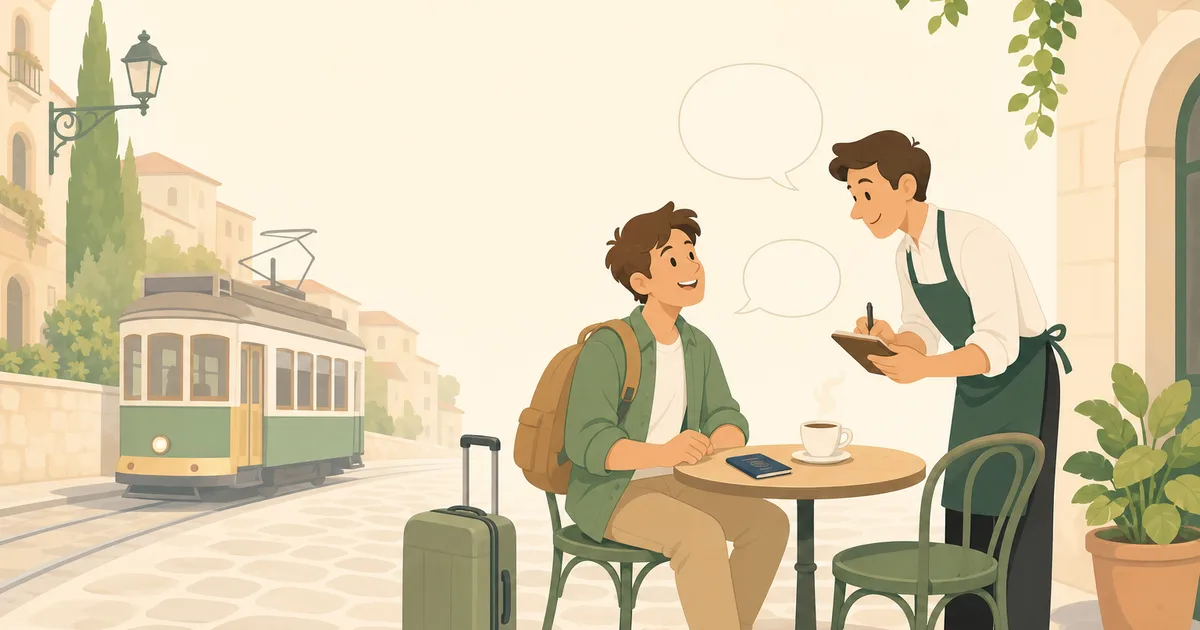
You do not need a language to travel, but about twenty-five phrases change the trip. With them you can greet people properly, buy a ticket, order, pay, find the toilet and ask for help, and most people meet you halfway the moment they hear you try. Learning them takes a week at fifteen minutes a day.
Below are 26 phrases sorted by the situations a trip actually consists of, each in Spanish, French and Italian with a reading hint, then a seven-day plan and the habits that make them stick.
Key points
- Learn whole phrases, not words: la cuenta, por favor works even if you could not explain a single word of its grammar.
- The polite opener matters more than the rest: bonjour before any question in France, buongiorno in Italy, disculpe to get attention in Spanish.
- Say every phrase out loud. Recognising a phrase on paper and producing it at a counter are two different skills, and only the second one helps you abroad.
- Learn the reply too: the waiter's "cash or card?" is half of the conversation.
How to read the hints
The hints use English spelling and are approximate; capitals mark the stressed syllable. Spanish and Italian are read almost exactly as written, so after a day the spelling itself is enough. French drops many final letters (passeport ends in "POR"), so the hints matter most there. Where Spain and Latin America differ, the table gives the version understood everywhere.
The phrases, situation by situation
Greetings and politeness
| English | Spanish | French | Italian |
|---|---|---|---|
| Hello | Hola (OH-lah) | Bonjour (bohn-ZHOOR) | Buongiorno (bwon-JOR-noh) |
| Please | Por favor (por fah-VOR) | S'il vous plaît (seel voo PLEH) | Per favore (pehr fah-VOH-reh) |
| Thank you | Gracias (GRAH-syahs) | Merci (mehr-SEE) | Grazie (GRAHT-tsyeh) |
| Excuse me | Disculpe (dees-KOOL-peh) | Excusez-moi (ex-kew-zay-MWAH) | Mi scusi (mee SKOO-zee) |
These four carry most of the goodwill. More of the same are on the everyday phrases page, each with its own page in all ten languages.
When you do not understand
| English | Spanish | French | Italian |
|---|---|---|---|
| I don't understand | No entiendo (noh en-TYEN-doh) | Je ne comprends pas (zhuh nuh kohn-PRAHN pah) | Non capisco (non kah-PEES-koh) |
| Could you repeat that, please? | ¿Puede repetirlo, por favor? (PWEH-deh reh-peh-TEER-loh) | Vous pouvez répéter, s'il vous plaît ? (voo poo-VAY ray-pay-TAY) | Può ripetere, per favore? (pwoh ree-PEH-teh-reh) |
| More slowly, please | Más despacio, por favor (mahs des-PAH-syoh) | Plus lentement, s'il vous plaît (plew lahnt-MAHN) | Più piano, per favore (pyoo PYAH-noh) |
This is the most useful group of all. Without it, the first fast answer ends the conversation; with it, you get a second, slower try.
Airport, transport and taxis
| English | Spanish | French | Italian |
|---|---|---|---|
| A ticket to the city centre, please | Un billete al centro, por favor (oon bee-YEH-teh ahl SEN-troh) | Un billet pour le centre-ville, s'il vous plaît (uhn bee-YEH poor luh sahn-truh-VEEL) | Un biglietto per il centro, per favore (oon bee-LYET-toh pehr eel CHEN-troh) |
| Does this bus go to the airport? | ¿Este autobús va al aeropuerto? (ES-teh ow-toh-BOOS vah ahl ah-eh-roh-PWER-toh) | Ce bus va à l'aéroport ? (suh bews vah ah lah-ay-roh-POR) | Questo autobus va all'aeroporto? (KWES-toh OW-toh-boos vah ahl-lah-eh-roh-POR-toh) |
| To this address, please | A esta dirección, por favor (ah ES-tah dee-rek-SYOHN) | À cette adresse, s'il vous plaît (ah set ah-DRESS) | A questo indirizzo, per favore (ah KWES-toh een-dee-REET-tsoh) |
In much of Latin America a ticket is a boleto rather than a billete. The last phrase is for a taxi: say it and show the address on your phone. Words like passport, luggage and boarding pass are collected on the city and travel page.
At the hotel
| English | Spanish | French | Italian |
|---|---|---|---|
| I have a reservation | Tengo una reserva (TEN-goh OO-nah reh-SER-vah) | J'ai une réservation (zhay ewn ray-zehr-vah-SYOHN) | Ho una prenotazione (oh OO-nah preh-noh-tah-TSYOH-neh) |
| What time is check-out? | ¿A qué hora hay que dejar la habitación? (ah keh OH-rah eye keh deh-HAR lah ah-bee-tah-SYOHN) | À quelle heure faut-il libérer la chambre ? (ah kel UR foh-TEEL lee-bay-RAY lah SHAHM-bruh) | A che ora devo lasciare la camera? (ah keh OH-rah DEH-voh lah-SHAH-reh lah KAH-meh-rah) |
| What's the Wi-Fi password? | ¿Cuál es la contraseña del wifi? (kwahl es lah kon-trah-SEH-nyah del WEE-fee) | Quel est le mot de passe du wifi ? (kel eh luh moh duh PAHSS dew wee-FEE) | Qual è la password del wifi? (kwah-LEH lah PASS-word del WHY-fy) |
Cafés and restaurants
| English | Spanish | French | Italian |
|---|---|---|---|
| A table for two, please | Una mesa para dos, por favor (OO-nah MEH-sah PAH-rah dohs) | Une table pour deux, s'il vous plaît (ewn TAH-bluh poor DUH) | Un tavolo per due, per favore (oon TAH-voh-loh pehr DOO-eh) |
| This one, please (pointing at the menu) | Esto, por favor (ES-toh) | Ça, s'il vous plaît (sah) | Questo, per favore (KWES-toh) |
| The bill, please | La cuenta, por favor (lah KWEN-tah) | L'addition, s'il vous plaît (lah-dee-SYOHN) | Il conto, per favore (eel KON-toh) |
Pointing plus "this one" is a complete strategy for a menu you cannot read. In Spain and Italy the bill rarely comes until you ask for it: lingering is the norm, not a sign that the waiter forgot you.
Shopping and money
| English | Spanish | French | Italian |
|---|---|---|---|
| How much is it? | ¿Cuánto cuesta? (KWAN-toh KWES-tah) | C'est combien ? (say kohm-BYAN) | Quanto costa? (KWAN-toh KOS-tah) |
| Can I pay by card? | ¿Puedo pagar con tarjeta? (PWEH-doh pah-GAR kon tar-HEH-tah) | Je peux payer par carte ? (zhuh puh peh-YAY par KART) | Posso pagare con la carta? (POS-soh pah-GAH-reh kon lah KAR-tah) |
| I'm just looking, thanks | Solo estoy mirando, gracias (SOH-loh es-TOY mee-RAHN-doh) | Je regarde juste, merci (zhuh ruh-GARD zhewst) | Sto solo guardando, grazie (stoh SOH-loh gwar-DAHN-doh) |
The answer to "how much" is a number, so learn one to ten and the tens before you go. Receipts, change and discounts are on the shopping and money page.
Finding your way
| English | Spanish | French | Italian |
|---|---|---|---|
| Where is the toilet? | ¿Dónde está el baño? (DOHN-deh es-TAH el BAH-nyoh) | Où sont les toilettes ? (oo sohn lay twah-LET) | Dov'è il bagno? (doh-VEH eel BAH-nyoh) |
| Where is the station? | ¿Dónde está la estación? (DOHN-deh es-TAH lah es-tah-SYOHN) | Où est la gare ? (oo eh lah GAR) | Dov'è la stazione? (doh-VEH lah stah-TSYOH-neh) |
| Is it far? | ¿Está lejos? (es-TAH LEH-hohs) | C'est loin ? (say LWAN) | È lontano? (eh lon-TAH-noh) |
Health and emergencies
| English | Spanish | French | Italian |
|---|---|---|---|
| Help! | ¡Socorro! (soh-KOH-rroh) | Au secours ! (oh suh-KOOR) | Aiuto! (ah-YOO-toh) |
| I need a doctor | Necesito un médico (neh-seh-SEE-toh oon MEH-dee-koh) | J'ai besoin d'un médecin (zhay buh-ZWAN duhn mayd-SAN) | Ho bisogno di un medico (oh bee-ZOH-nyoh dee oon MEH-dee-koh) |
| Is there a pharmacy near here? | ¿Hay una farmacia cerca? (eye OO-nah far-MAH-syah SER-kah) | Il y a une pharmacie près d'ici ? (eel ee ah ewn far-mah-SEE preh dee-SEE) | C'è una farmacia qui vicino? (cheh OO-nah far-mah-CHEE-ah kwee vee-CHEE-noh) |
| I've lost my passport | He perdido mi pasaporte (eh per-DEE-doh mee pah-sah-POR-teh) | J'ai perdu mon passeport (zhay pehr-DEW mohn pahss-POR) | Ho perso il passaporto (oh PEHR-soh eel pahs-sah-POR-toh) |
Learn this group even if you skip the others. The emergency number across the EU is 112.
The seven days before the trip
Fifteen minutes a day, one language, out loud.
- Day 1. Greetings and the three "I don't understand" phrases. Say each one ten times until it comes out without thinking.
- Day 2. Repeat day 1 from memory first, then transport and the hotel.
- Day 3. Repeat, then cafés and restaurants. Practise the whole exchange: hello, a table, this one, the bill, thank you.
- Day 4. Shopping and money, plus the numbers to twenty and the tens.
- Day 5. Directions and emergencies.
- Day 6. Scenes. Act out arriving at the hotel, ordering dinner and buying a ticket, with someone playing the other side.
- Day 7. Go through all 26 phrases from the English side without looking, and put the ones you missed at the top of tomorrow's list, which is the first day of the trip.
How to make them stick
Review just before you forget. Repeating a phrase five times in one evening helps less than seeing it again the next day and then three days later; that is spaced repetition, and it is why the plan starts each day with yesterday.
Say it, do not just read it. Your mouth needs to have made the sounds before the moment at the counter. A phrase you have only read tends to freeze when someone is waiting; one you have said twenty times comes out. More on this in speaking from day one.
Play the scene with two people. If you travel with someone, take turns as tourist and waiter. It feels silly for a minute and works better than any list, because it trains the order of the conversation, not just the lines.
Expect the reply. At a Spanish café you will hear ¿para tomar aquí o para llevar? (for here or to take away?), at a till ¿efectivo o tarjeta? (cash or card?), and almost everywhere ¿algo más? (anything else?). Knowing two or three of these turns a phrase into a conversation.
Small courtesies that matter
- France: bonjour first, always. Walking into a shop or up to a counter and asking a question without it comes across as rude. Add madame or monsieur and the tone of the exchange changes.
- Italy: the time of day counts. Buongiorno until mid-afternoon, then buonasera. Ciao is for friends; with strangers, mi scusi and per favore.
- Spanish: usted is the safe default with older people and staff in formal places. All the phrases above already use it, so you do not have to choose.
- Tipping is smaller than in the US. In Spain, France and Italy service is usually included, and rounding up or leaving a little change is enough.
- A wrong word with a smile beats silence. People forgive mistakes in their language far more readily than they forgive not trying.
Where LinguaPair fits
Many of these phrases are also pages of the LinguaPair dictionary, each with the phrase in all ten languages and an example sentence in every one of them, so the theme pages above double as a ready-made list. If you want more than a week's worth, the Spanish course and the others start from zero in short lessons, and the A0 and A1 levels are free. Words you add to the vocabulary trainer come back on a spaced-repetition schedule, so the reviews plan themselves.
For the moments the phrases run out, the live translator has an in-person mode on one phone: you speak English, the other person answers in their language, and each line appears translated. It is free for ten minutes a day, and the words from the conversation land in your trainer, so what you needed on the trip becomes what you learn next.