 Lingua
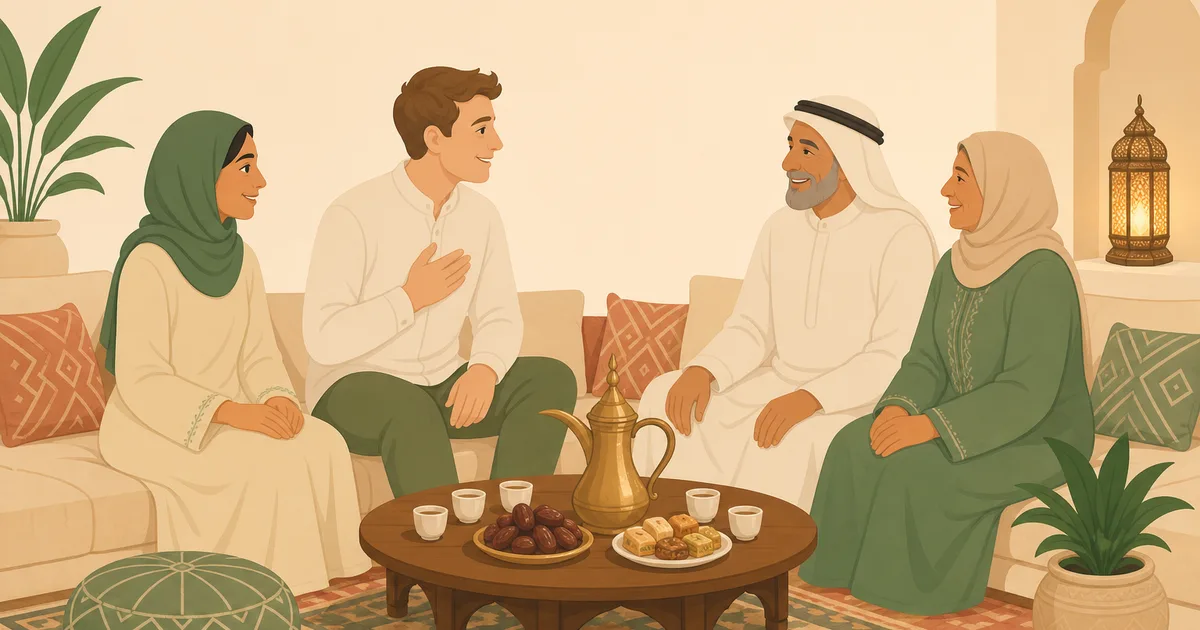
In most Arabic-speaking families, meeting your partner's parents is a matter of hospitality first and conversation second. You will be welcomed at the door, seated in the best room, offered coffee or tea before you have taken your coat off, and fed more than you thought possible. The parents want to see respect: for them, for the older relatives, for the house. A handful of phrases said with warmth, and a few habits of the table, tell them more about you than any CV.
Here are thirty phrases for the visit, with a reading hint for English speakers, followed by the etiquette Arab families take for granted, the most common mistakes and a two-week plan to prepare.
Key points
- Families speak their own dialect at home: Egyptian, Levantine, Gulf, Iraqi or Maghrebi. The phrases below are Modern Standard Arabic chosen to be understood everywhere, and many of them, like as-salamu alaykum and ma sha' Allah, are said exactly the same way in every dialect. Ask your partner which local versions their parents use.
- Respect for elders is the heart of the visit. Stand up when the parents enter, greet the oldest person first, and call the parents uncle and aunt or whatever your partner suggests, never by their first names.
- Hospitality is insistent by design. Refuse a second helping once if you like, accept when they insist, and praise the cook by name.
Before the visit
- Ask your partner about the family. A family in Cairo, Amman, Riyadh, Beirut or Casablanca can differ a great deal: how religious they are, whether men and women greet each other with a handshake, how formal the first visit is.
- Bring something. A box of sweets from a good pastry shop, dates or chocolates are always right. Flowers are welcome in many cities. In a Muslim family, never bring alcohol.
- Dress modestly. Shoulders and knees covered is the safe choice for both men and women. Many homes are shoe-free: watch the doorway and follow the family.
- Learn the names, and the titles. You will meet the parents and probably grandparents, aunts, uncles and cousins. Your partner will tell you whether to say uncle and aunt, a title, or something else.
The 30 phrases
The hints use English spelling; capitals mark the stressed syllable. Arabic has a few sounds English lacks: kh is the rough sound in Scottish "loch", gh is a gargled r like French r, h in bold places such as HAD is a breathy h from deep in the throat, q is a k made far back in the mouth, and an apostrophe marks a short catch in the throat (the letter ayn or a glottal stop). Th sounds as in "think" and dh as in "this". Double consonants are really held longer, and long vowels, written aa, ee and oo in the hints, are really long. Some words change with the person you talk to or with your own gender: a woman says sa'eeda where a man says sa'eed. ○○ marks a name or a word to fill in.
Greetings and first words
| Arabic | Say it like | Meaning |
|---|---|---|
| السلام عليكم | as-sa-LAA-mu a-LAY-kum | Peace be upon you: the greeting everyone uses. The answer is wa alaykum as-salam. |
| مساء الخير | ma-SAA' al-KHAYR | Good evening. Before the afternoon, sabah al-khayr. |
| أنا ○○، تشرّفنا. | A-na ○○, ta-SHAR-raf-naa | I'm ○○, it's an honour to meet you. |
| شكرًا على الدعوة. | SHUK-ran a-lad-DA'-wa | Thank you for the invitation. |
| أخيرًا التقينا! | a-KHEE-ran il-ta-QAY-naa | At last we meet! |
| حدّثني ○○ عنكم كثيرًا. | HAD-da-tha-nee ○○ AN-kum ka-THEE-ran | ○○ has told me so much about you. If your partner is a woman: had-da-THAT-nee. |
Polite forms and asking for help
| Arabic | Say it like | Meaning |
|---|---|---|
| عمّي، خالتي | AM-mee, KHAA-la-tee | Uncle, aunt: the warm, respectful way to address your partner's father and mother, until they suggest something else. |
| أحضرت لكم هدية صغيرة. | ah-DAR-tu LA-kum ha-DIY-ya sa-GHEE-ra | I brought you a little gift. |
| ما زلت أتعلم العربية. | maa ZIL-tu a-ta-'AL-la-mul a-ra-BIY-ya | I'm still learning Arabic. |
| هل يمكن أن تتكلموا ببطء قليلًا؟ | hal YUM-kin an ta-ta-KAL-la-moo bi-BUT' qa-LEE-lan | Could you speak a little more slowly? |
| عفوًا، هل يمكن أن تعيدوا؟ | 'AF-wan, hal YUM-kin an tu-'EE-doo | Sorry, could you say that again? |
| كيف نقول ○○ بالعربية؟ | KAY-fa na-QOOL ○○ bil-a-ra-BIY-ya | How do you say ○○ in Arabic? |
At the table
| Arabic | Say it like | Meaning |
|---|---|---|
| بسم الله | bis-mil-LAAH | In the name of God: many families say it as the meal begins. |
| ما شاء الله، البيت جميل! | maa SHAA' al-laah, al-BAYT ja-MEEL | What a beautiful home! Ma sha' Allah goes with every compliment. |
| رائحة الطعام رائعة! | RAA-i-hat at-ta-'AAM RAA-i-'a | The food smells wonderful! |
| الطعام لذيذ جدًا! | at-ta-'AAM la-DHEEDH JID-dan | The food is delicious! |
| سلمت يداكِ! | sa-LI-mat ya-DAA-ki | Bless your hands: the compliment for whoever cooked. To a man, ya-DAA-ka. |
| علّميني هذه الوصفة، من فضلكِ. | al-li-MEE-nee HAA-dhi-hil WAS-fa, min FAD-li-ki | Please teach me this recipe (to a woman). |
| شكرًا، شبعت والحمد لله. | SHUK-ran, sha-BI'-tu wal-HAM-du lil-LAAH | Thank you, I'm full, thank God. The polite way to say no more. |
| هل أستطيع أن أساعدكم؟ | hal as-ta-TEE-'u an u-SAA-'i-da-kum | Can I help you with anything? |
Small talk
| Arabic | Say it like | Meaning |
|---|---|---|
| أنا من ○○. | A-na min ○○ | I'm from ○○. |
| أعمل ○○. | A'-ma-lu ○○ | I work as ○○. |
| أحب بلدكم كثيرًا. | u-HIB-bu ba-la-DA-kum ka-THEE-ran | I love your country very much. |
| تعارفنا في ○○. | ta-'AA-raf-naa fee ○○ | We met in ○○. |
| ○○ عزيز جدًا عليّ. | ○○ a-ZEEZ JID-dan a-LAY-ya | ○○ is very dear to me. About a woman: a-ZEE-za. |
Thanks and goodbye
| Arabic | Say it like | Meaning |
|---|---|---|
| شكرًا على كل شيء. | SHUK-ran a-laa KUL-li SHAY' | Thank you for everything. |
| كانت أمسية جميلة جدًا. | KAA-nat um-SI-ya ja-MEE-la JID-dan | It's been a lovely evening. |
| تأخر الوقت، نستأذن. | ta-'AKH-kha-ral WAQT, nas-ta'-DHIN | It's getting late, we'll take our leave. The polite way to start leaving. |
| إن شاء الله نراكم قريبًا. | in SHAA' al-laah na-RAA-kum qa-REE-ban | God willing, we'll see you again soon. |
| مع السلامة! | MA-'as sa-LAA-ma | Goodbye! The usual reply is Allah ysallimak, or the same words back. |
Etiquette Arab families take for granted
- Greetings follow the family's lead. In many families men shake hands with men and women greet women, often with kisses on the cheeks, while a man and a woman who are not related may not touch at all. Wait for the other person to offer a hand, and if they put a hand on their heart instead, do the same.
- The right hand. Eat, pass dishes and hand over the gift with your right hand, or with both.
- Coffee and tea come first. In the Gulf, Arabic coffee is poured into a small cup a little at a time; when you have had enough, gently shake the cup from side to side as you hand it back. Elsewhere, tea or coffee comes with sweets.
- The host insists. Saying no once is polite and expected; the second or third offer is the real one. Finishing what is on your plate may bring more, so leave a little when you are truly full, if your partner says that is the custom.
- Compliments carry a blessing. Praise the home, the food and the children, and add ma sha' Allah: it wards off envy and shows good manners.
- Couples are discreet. Holding hands or kissing in front of the parents is out of place at a first meeting, even in relaxed families.
Common mistakes
- Calling the parents by their first names. Use uncle and aunt, a title, or what your partner suggests.
- Bringing wine or pork-based food, or offering a handshake to a parent who did not offer one.
- Showing the soles of your feet, or resting your feet on the table or a cushion. Sit with both feet on the floor.
- Refusing everything. If you have a dietary rule, tell your partner beforehand so the family can plan; refusing every dish at the table looks like a verdict on the cooking.
- Worrying that Standard Arabic sounds stiff. It does, a little, like a news presenter. The family will smile, and your effort is what they remember. Learn two or three words of their dialect from your partner as a bonus.
- Leaving straight after the meal. Stay for tea, coffee and sweets, then use ta'akhkhara al-waqt, nasta'dhin.
A two-week practice plan
- Days 1–3: the doorway. Say as-salamu alaykum, masa' al-khayr, ana ○○, tasharrafna and shukran ala ad-da'wa aloud every day, standing up, as if greeting the parents.
- Days 4–6: the table. Practise bismillah, at-ta'am ladheedh jiddan, salimat yadaki and shabi'tu wal-hamdu lillah during real meals; work on the throat sounds.
- Days 7–9: the questions. Prepare short answers about your work, your family, your country, your plans and how you met. Your partner plays the parents and asks the questions they are sure to ask.
- Days 10–12: the whole visit. Role-play from the doorbell to ma'a as-salama, coffee included.
- Days 13–14: polish. Fix one sound per phrase, learn the dialect versions your partner chooses, and pick the ten phrases you will definitely use.
How LinguaPair helps you get ready
LinguaPair is made for couples who learn each other's languages (this is how it works for two). You invite your partner and your two accounts become a pair: you follow your own Arabic course in short lessons, starting at A0 with the Arabic alphabet and its sounds, with A0 and A1 free, and each of you sees the other's level and streak. The course teaches Modern Standard Arabic, the Arabic of books and news that every Arab family understands. Games against each other, translation duels and vocabulary races, are built from your words and turn the phrases above into a contest. On the day itself, the live translator works on one phone at the table: each person speaks their own language and every line is translated as you go, so the father can ask about your plans and you can answer with more than na'am. The words from those conversations land in your vocabulary trainer for the next visit. Games and unlimited translation come with Premium, and one subscription covers both of you.
The same visit has very different rules elsewhere: compare meeting French parents and meeting Italian parents. A new script looks harder than it is; learning a new alphabet shows how to make one stick in two weeks. If a wedding is next, continue with a toast and vows in your partner's language, and for the first words of love, how to say I love you in 10 languages.