 Lingua
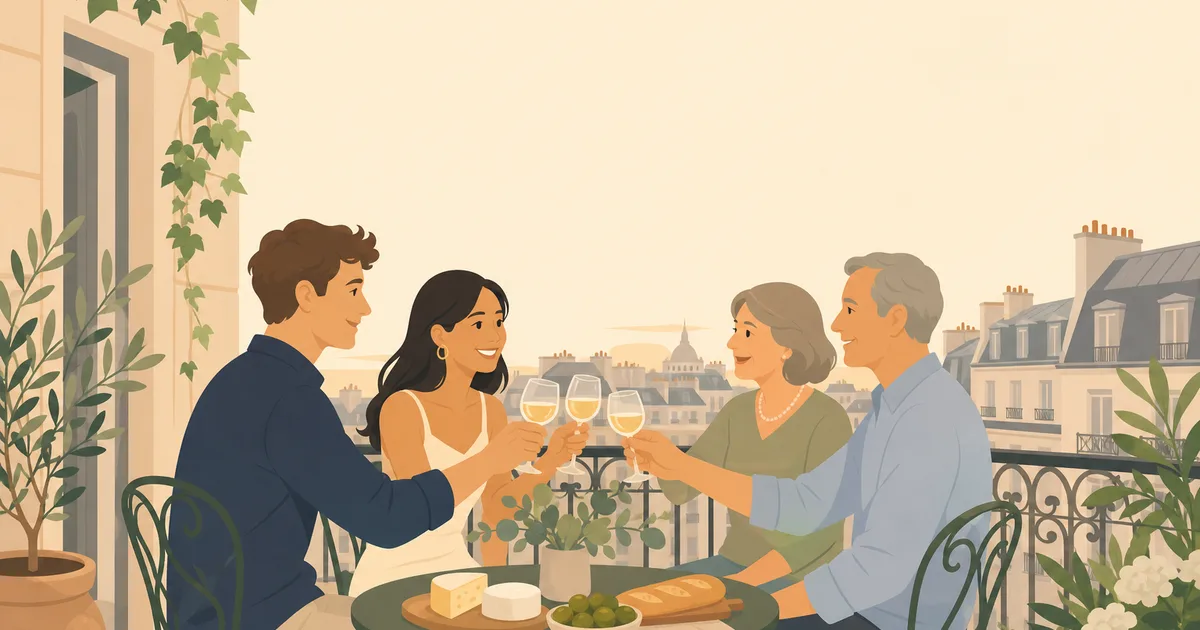
Meeting your partner's parents in France is usually a dinner, and a French dinner has a shape: an apéritif, a starter, a main course, cheese, dessert, coffee, and a great deal of conversation in between. French parents are often more reserved at first than Italian or Spanish ones, but they care a lot about form. A proper bonjour, the right choice between tu and vous, and a real opinion or two at the table count for more than a perfect accent.
Below are thirty phrases with a reading hint for English speakers, followed by the etiquette French families take for granted, what changes in Belgium, Switzerland and Québec, the most common mistakes and a two-week plan.
Key points
- Say bonjour or bonsoir to each person, with madame or monsieur, and use vous until the parents suggest on peut se tutoyer, "we can say tu". Some families switch in an hour, some take months.
- La bise, the kiss on both cheeks, is common even at a first meeting in many families; the number of kisses changes by region. Let them lead.
- Conversation is part of the meal. Having an opinion, and defending it politely, is a compliment to your hosts, not a breach of manners.
Before the visit
- Ask your partner how the family works. Paris, Lyon, Brittany and Marseille differ, and so do generations: the number of kisses, the speed of tu, the length of dinner.
- Bring something, but think about it. Good chocolates, a dessert from a pastry shop or flowers are safe. Wine is fine too, but in some families the host has chosen the wine to match the meal, so do not expect yours to be opened. Never chrysanthemums: they are for graves.
- Arrive ten to fifteen minutes late. The quart d'heure de politesse gives the hosts time to finish; arriving early is the real faux pas.
- Do not come hungry for an early meal. Dinner rarely starts before eight, and the apéritif comes first.
The 30 phrases
The hints use English spelling; capitals are not used because French stresses the last syllable of a phrase lightly and evenly. An "n" after a vowel in the hints (ahn, ohn, an) is not pronounced: it makes the vowel nasal. "Zh" is the s in "measure", "uh" is a short neutral vowel, and "ü" is "ee" said with rounded lips. Final consonants are mostly silent. A woman writes enchantée and heureuse; the first sounds the same, the second ends in "uhz". ○○ marks a name or a word to fill in.
Greetings and first words
| French | Say it like | Meaning |
|---|---|---|
| Bonsoir madame, bonsoir monsieur. | bohn-swahr mah-dahm, bohn-swahr muh-syuh | Good evening, madam, sir. Before evening: bonjour. |
| Enchanté. | ahn-shahn-tay | Delighted to meet you. |
| Je suis ○○. | zhuh swee ○○ | I'm ○○. |
| Merci beaucoup pour l'invitation. | mehr-see boh-koo poor lan-vee-tah-syohn | Thank you very much for the invitation. |
| ○○ m'a beaucoup parlé de vous. | ○○ mah boh-koo par-lay duh voo | ○○ has told me a lot about you. |
| Je suis très heureux de vous rencontrer enfin. | zhuh swee tray zuh-ruh duh voo rahn-kohn-tray ahn-fan | I'm very happy to meet you at last. |
Polite forms and asking for help
| French | Say it like | Meaning |
|---|---|---|
| Je vous en prie. | zhuh voo zahn pree | You're welcome, or please go ahead: the polite answer to merci. |
| J'ai apporté un petit quelque chose. | zhay ah-por-tay uhn puh-tee kel-kuh shohz | I brought a little something. |
| J'apprends encore le français. | zhah-prahn ahn-kor luh frahn-seh | I'm still learning French. |
| Pourriez-vous parler un peu plus lentement ? | poo-ryay voo par-lay uhn puh plü lahnt-mahn | Could you speak a little more slowly? |
| Pardon, vous pouvez répéter ? | par-dohn, voo poo-vay ray-pay-tay | Sorry, could you say that again? |
| Comment dit-on ça en français ? | koh-mahn dee-tohn sah ahn frahn-seh | How do you say that in French? |
At the table
| French | Say it like | Meaning |
|---|---|---|
| Vous avez une très belle maison. | voo zah-vay zün tray bel meh-zohn | You have a beautiful home. |
| Ça sent très bon ! | sah sahn tray bohn | That smells wonderful! |
| Bon appétit ! | boh nah-pay-tee | Enjoy your meal! |
| C'est délicieux ! | say day-lee-syuh | It's delicious! |
| Vous me donnerez la recette ? | voo muh dohn-ray lah ruh-set | Will you give me the recipe? |
| Je peux en reprendre un peu ? | zhuh puh ahn ruh-prahndr uhn puh | May I have a little more? |
| Merci, je n'ai plus faim, c'était excellent. | mehr-see, zhuh nay plü fan, say-teh tek-seh-lahn | Thank you, I'm full, it was excellent. |
| Je peux vous aider à débarrasser ? | zhuh puh voo zay-day ah day-bah-rah-say | Can I help you clear the table? |
Small talk
| French | Say it like | Meaning |
|---|---|---|
| Je viens de ○○. | zhuh vyan duh ○○ | I'm from ○○. |
| Je travaille dans ○○. | zhuh trah-vye dahn ○○ | I work in ○○. |
| J'adore la cuisine française. | zhah-dor lah kwee-zeen frahn-sez | I love French food. |
| Nous nous sommes rencontrés à ○○. | noo noo sum rahn-kohn-tray ah ○○ | We met in ○○. |
| ○○ compte beaucoup pour moi. | ○○ kohnt boh-koo poor mwah | ○○ means a lot to me. |
Thanks and goodbye
| French | Say it like | Meaning |
|---|---|---|
| Merci pour tout. | mehr-see poor too | Thank you for everything. |
| J'ai passé une excellente soirée. | zhay pah-say ün ek-seh-lahnt swah-ray | I've had a wonderful evening. |
| Il se fait tard, je vais vous laisser. | eel suh feh tar, zhuh vay voo lay-say | It's getting late, I'll leave you to your evening. |
| J'espère vous revoir bientôt. | zhes-pehr voo ruh-vwahr byan-toh | I hope to see you again soon. |
| Bonne soirée, au revoir ! | bun swah-ray, oh ruh-vwahr | Have a good evening, goodbye! |
Etiquette French families take for granted
- Bonjour first, always. Entering a room without greeting each person is rude in France. Say bonjour madame, bonjour monsieur, without the surname, then follow their lead on the bise or a handshake.
- The apéritif is a course. Drinks and small bites come first, often for half an hour or more. Pace yourself; dinner has not started yet.
- Bread goes on the table. Put your piece next to your plate, not on it, and break it with your hands rather than cutting it.
- Cheese before dessert. Take a little of two or three cheeses, and never cut the tip off a wedge: cut along it so the next person gets the same share of rind and heart.
- Hands on the table, wrists resting on the edge. Hands in your lap look odd at a French table.
- Debate is welcome, money is not. Food, books, travel and even politics are fine; asking what someone earns is not.
- Finish your plate, and say why you liked it. A specific compliment about the sauce or the cheese goes further than a general one.
Belgium, Switzerland and Québec
In Belgium a single kiss is common; in French-speaking Switzerland, often three. In Québec people switch to tu much faster, dinner may be called souper, and bienvenue is the usual answer to merci. Some words change too: septante and nonante for seventy and ninety in Belgium and Switzerland. Ask your partner which French the family speaks.
Common mistakes
- Using tu before you are invited to. Wait for on peut se tutoyer or tu peux me tutoyer.
- Skipping bonjour. Starting with a question, or with salut, at a first meeting sounds abrupt.
- Arriving early or coming hungry and attacking the apéritif snacks as if they were dinner.
- Saying je suis pleine to mean "I'm full". For an animal it means pregnant; say je n'ai plus faim.
- Staying silent all evening. A modest opinion, or a question about the region, is better than polite silence.
A two-week practice plan
- Days 1–3: the doorway. Bonsoir madame, bonsoir monsieur, enchanté, je suis ○○, with the bise your partner's family uses.
- Days 4–6: the table. Practise bon appétit, c'est délicieux and je peux en reprendre un peu ? during real meals; work on the nasal vowels.
- Days 7–9: the questions. Prepare short answers about your work, your family, your country and how you met, and one opinion on French food. Your partner plays the parents, using vous.
- Days 10–12: the whole evening. From the apéritif to il se fait tard, je vais vous laisser.
- Days 13–14: polish. Fix one sound per phrase, usually the u and the r, and choose the ten phrases you will definitely use.
How LinguaPair helps you get ready
LinguaPair is made for two people learning each other's languages at the same time. You invite your partner and your two accounts become a pair: you follow your own French course in short lessons, with the A0 and A1 levels free, and each of you sees the other's level and streak. Games against each other, translation duels and vocabulary races, are built from your words and turn the phrases above into a contest. On the evening itself, the live translator works on one phone at the table: each person speaks their own language and every line is translated as you go, so you can take part in the discussion instead of nodding through it. The words from those conversations land in your vocabulary trainer for the next dinner. Games and unlimited translation come with Premium, and one subscription covers both of you.
Compare the same visit elsewhere: meeting Spanish-speaking parents, Italian parents, Brazilian parents, Korean parents and Japanese parents. If a wedding is next, continue with a toast and vows in your partner's language, and see why je t'aime bien is less than je t'aime in how to say I love you in 10 languages.
For a German or a Vietnamese family, see 30 phrases for meeting German parents and 30 phrases for meeting Vietnamese parents.