 Lingua
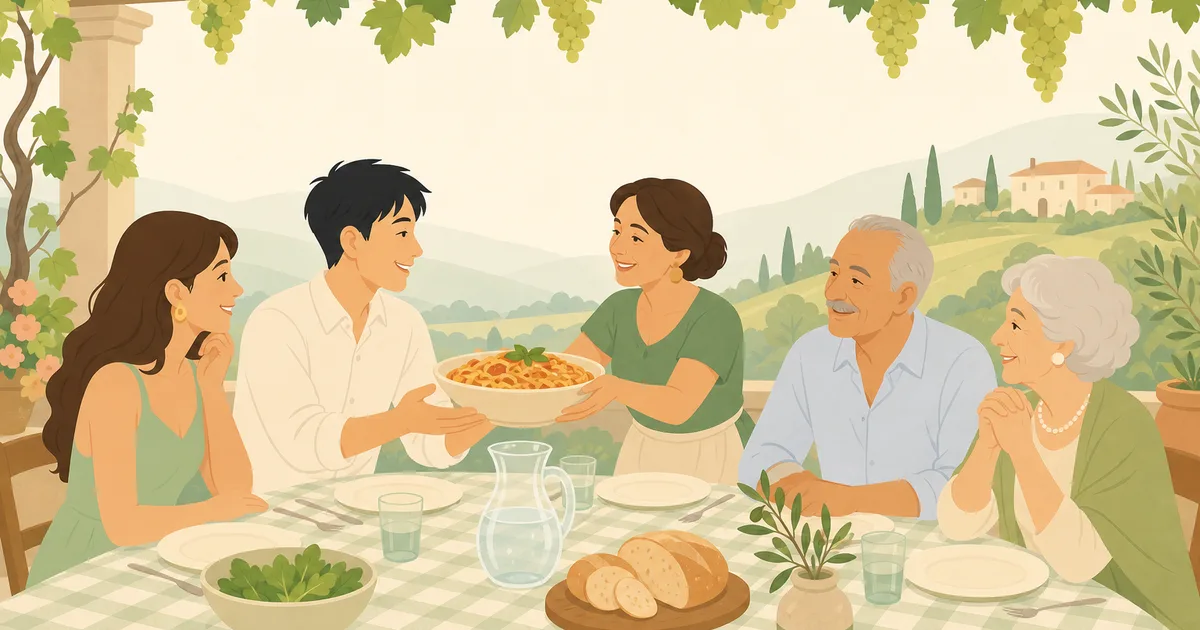
In Italy, meeting your partner's parents almost always means a meal, and the meal is the conversation. The mother has probably been cooking since morning, the father will want to know what you do and where you are from, and somebody will tell you to eat more before you have finished your first plate. Italian parents are warm, curious and quick to judge sincerity by how you behave at their table. A handful of phrases in the right register goes a very long way.
Here are thirty phrases for the visit, with a reading hint for English speakers, followed by the etiquette Italian families take for granted, the most common mistakes and a two-week plan to prepare.
Key points
- Start with the formal Lei for each parent and voi for both together, and wait until they say diamoci del tu, "let's use tu". Many will say it within the hour; let it come from them.
- Ciao is too casual for a first meeting with parents. Say buonasera or buongiorno when you arrive and arrivederci when you leave.
- The meal has a rhythm of several courses. Pace yourself, praise the cooking out loud, and say yes to a second helping at least once.
Before the visit
- Ask your partner about the family. A Sunday lunch in a southern family and a dinner in a northern city can feel like two different countries: bigger tables and more insistence in the south, more restraint in the north.
- Bring something. A tray of pastries from a good pasticceria, a bottle of wine or something typical of your country. Flowers are lovely, but never chrysanthemums: in Italy they belong to funerals.
- Arrive on time or a few minutes late, never early. Dress neatly; Italians notice.
- Learn the names. You will meet the parents first, and possibly a grandmother, an aunt and a cousin. Use signora and signore with older relatives until told otherwise.
The 30 phrases
The hints use English spelling; capitals mark the stressed syllable. Italian vowels are pure and short, never glided: e is "eh", o is "oh". Double consonants are really held longer, so tutto is "TOOT-toh" with a tiny pause on the t. C and g before e or i are soft ("ch", "j"), gn sounds like "ny" in "canyon", and gl in voglio like "lli" in "million". The r is a quick tap of the tongue. Adjectives agree with the speaker, so a woman says pieno as piena. ○○ marks a name or a word to fill in.
Greetings and first words
| Italian | Say it like | Meaning |
|---|---|---|
| Buonasera! | bwoh-nah-SEH-rah | Good evening! Use buongiorno before the afternoon. |
| Piacere, sono ○○. | pyah-CHEH-reh, SOH-noh ○○ | Nice to meet you, I'm ○○. Said with a handshake. |
| Permesso? | pehr-MEHS-soh | "May I?", said as you step into the home. The answer is avanti or prego. |
| Grazie dell'invito. | GRAHT-tsyeh del-leen-VEE-toh | Thank you for inviting me. |
| Finalmente vi conosco! | fee-nahl-MEN-teh vee koh-NOH-skoh | At last I get to meet you! |
| ○○ mi ha parlato tanto di voi. | ○○ mee ah pahr-LAH-toh TAHN-toh dee voy | ○○ has told me so much about you. |
Polite forms and asking for help
| Italian | Say it like | Meaning |
|---|---|---|
| Signora ○○, signor ○○ | see-NYOH-rah ○○, see-NYOHR ○○ | Mrs ○○, Mr ○○, with the surname, until they invite you to use first names. |
| Ho portato un pensierino. | oh por-TAH-toh oon pen-syeh-REE-noh | I brought a little something. |
| Sto ancora imparando l'italiano. | stoh ahn-KOH-rah eem-pah-RAHN-doh lee-tah-LYAH-noh | I'm still learning Italian. |
| Può parlare un po' più piano? | pwoh pahr-LAH-reh oon POH pyoo PYAH-noh | Could you speak a little more slowly? |
| Scusi, può ripetere? | SKOO-zee, pwoh ree-PEH-teh-reh | Sorry, could you repeat that? |
| Come si dice in italiano? | KOH-meh see DEE-cheh een ee-tah-LYAH-noh | How do you say it in Italian? |
At the table
| Italian | Say it like | Meaning |
|---|---|---|
| Che bella casa! | keh BEL-lah KAH-zah | What a beautiful home! |
| Che profumino! | keh proh-foo-MEE-noh | That smells wonderful! |
| Buon appetito! | bwohn ahp-peh-TEE-toh | Enjoy your meal: said by everyone as the eating starts. |
| È buonissimo! | EH bwoh-NEES-see-moh | It's absolutely delicious! |
| Me lo insegna? | meh loh een-SEH-nyah | Would you teach me how to make it? |
| Posso fare il bis? | POHS-soh FAH-reh eel beess | May I have seconds? |
| Sono pieno, era tutto squisito. | SOH-noh PYEH-noh, EH-rah TOOT-toh skwee-ZEE-toh | I'm full, everything was exquisite. |
| Posso darLe una mano? | POHS-soh DAHR-leh OO-nah MAH-noh | Can I give you a hand? |
Small talk
| Italian | Say it like | Meaning |
|---|---|---|
| Sono di ○○. | SOH-noh dee ○○ | I'm from ○○. |
| Lavoro come ○○. | lah-VOH-roh KOH-meh ○○ | I work as ○○. |
| Mi piace tantissimo l'Italia. | mee PYAH-cheh tahn-TEES-see-moh lee-TAH-lyah | I love Italy so much. |
| Ci siamo conosciuti a ○○. | chee SYAH-moh koh-noh-SHOO-tee ah ○○ | We met in ○○. |
| ○○ è una persona speciale per me. | ○○ EH OO-nah pehr-SOH-nah speh-CHAH-leh pehr meh | ○○ is a very special person to me. |
Thanks and goodbye
| Italian | Say it like | Meaning |
|---|---|---|
| Grazie di tutto. | GRAHT-tsyeh dee TOOT-toh | Thank you for everything. |
| È stata una serata bellissima. | EH STAH-tah OO-nah seh-RAH-tah bel-LEES-see-mah | It's been a wonderful evening. |
| Si è fatto tardi, tolgo il disturbo. | see EH FAHT-toh TAHR-dee, TOHL-goh eel dee-STOOR-boh | It's getting late, I'll leave you in peace. The polite way to start leaving. |
| Spero di rivedervi presto. | SPEH-roh dee ree-veh-DEHR-vee PREH-stoh | I hope to see you again soon. |
| ArrivederLa! Arrivederci! | ahr-ree-veh-DEHR-lah, ahr-ree-veh-DEHR-chee | Goodbye: the first to one person with Lei, the second to everyone. |
Etiquette Italian families take for granted
- Handshake first, kisses later. At a first meeting a firm handshake and eye contact are normal; two kisses on the cheeks usually come at the goodbye or the next visit, once the family offers them.
- The meal has an order. Antipasto, primo (pasta or risotto), secondo (meat or fish) with a side dish, then fruit or dessert and an espresso. Do not fill up on bread before the pasta arrives.
- "Mangia, mangia!" The cook will insist. A polite no once is fine, but finishing your plate and taking a little more is the warmest thing you can say.
- Coffee rules are real. Espresso after the meal, not cappuccino; cappuccino belongs to the morning.
- Praise specifically. "The sauce is incredible" works better than a generic "good". Asking who taught the recipe often opens a family story.
- Bread and hands. Keep your hands visible on the table, not in your lap. Wiping the last sauce with bread, fare la scarpetta, is fine at a family table once others do it.
Common mistakes
- Saying ciao to the parents at the first meeting. It is the greeting of friends. Use buonasera and arrivederci.
- Switching to tu on your own. Wait for dammi del tu or diamoci del tu. When it comes, it is a small honour; accept it with a smile.
- Cutting spaghetti with a knife or asking for parmesan on seafood pasta. Twirl with the fork against the plate, and trust the cook's choices.
- Refusing every course. If you have a dietary rule, tell your partner beforehand so the family can plan; refusing at the table looks like a verdict on the food.
- Leaving straight after dessert. Stay for coffee and a bit of conversation, then use tolgo il disturbo.
A two-week practice plan
- Days 1–3: the doorway. Say Buonasera, Permesso?, Piacere, sono ○○ and Grazie dell'invito out loud every day, with a handshake.
- Days 4–6: the table. Practise Buon appetito, È buonissimo and Posso fare il bis? during real meals; work on double consonants.
- Days 7–9: the questions. Prepare short answers about your work, your family, your country and how you met. Your partner plays the parents, using Lei with you.
- Days 10–12: the whole visit. Role-play from the doorbell to tolgo il disturbo.
- Days 13–14: polish. Fix one sound per phrase and choose the ten phrases you will definitely use.
How LinguaPair helps you get ready
LinguaPair is made for couples who learn each other's languages (here is how it works for two). You invite your partner and your two accounts become a pair: you follow your own Italian course in short lessons, with the A0 and A1 levels free, and each of you sees the other's level and streak. Games against each other, translation duels and vocabulary races, are built from your words and turn the phrases above into a contest. On the day itself, the live translator works on one phone at the table: each person speaks their own language and every line is translated as you go, so the father can ask his questions and you can answer more than sì. The words from those conversations land in your vocabulary trainer for the next Sunday lunch. Games and unlimited translation come with Premium, and one subscription covers both of you.
The same visit has very different rules elsewhere: compare meeting Brazilian parents, meeting Korean parents and meeting Japanese parents. If a wedding is next, continue with a toast and vows in your partner's language, and read why ti amo is never for the in-laws in how to say I love you in 10 languages.
For a Spanish-speaking or a French family, see 30 phrases for meeting Spanish-speaking parents and 30 phrases for meeting French parents.