 Lingua
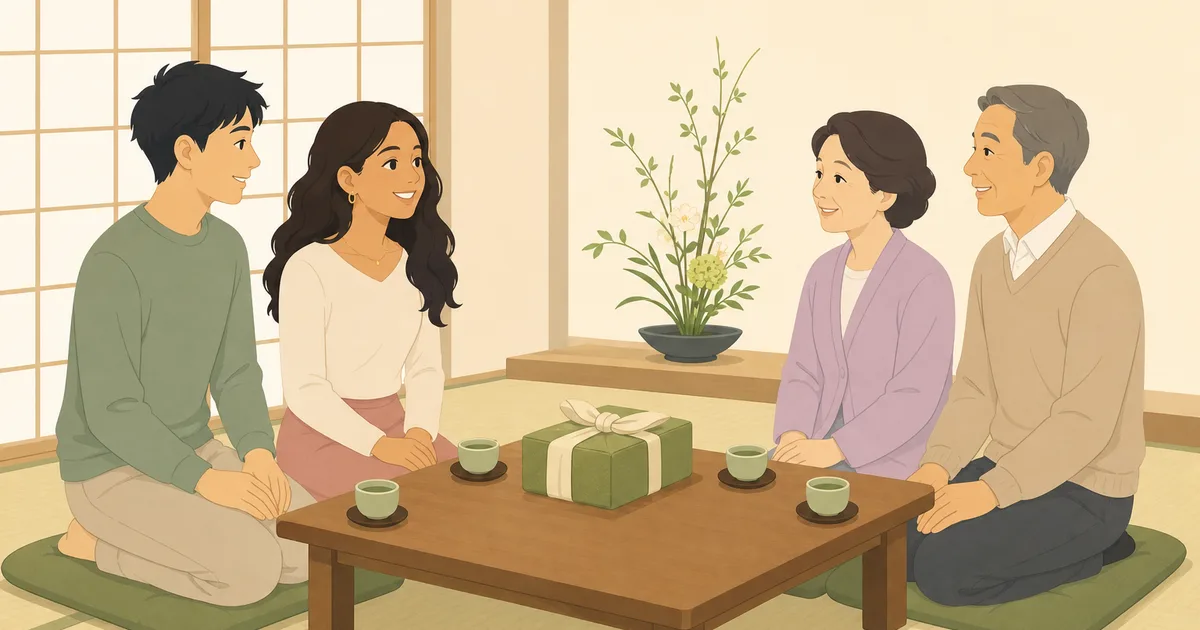
In Japan the first visit to a partner's parents has a name of its own: 挨拶 (aisatsu), "the greeting". It is a formal step, and Japanese parents tend to judge sincerity by manners rather than by fluency. They will notice whether you use polite language, 敬語 (keigo), whether you brought a small gift, お土産 (omiyage), and how you move through their home, from the shoes at the door to the chopsticks at the table.
Here are thirty phrases for the visit, in Japanese with romaji for English speakers, followed by the etiquette that Japanese families take for granted, the mistakes foreign partners make most often, and a two-week plan to prepare.
Key points
- Speak in the polite です/ます form at the very least. The phrases below add the humble keigo (申します, いたします) that a Japanese speaker would use at a first meeting.
- The omiyage matters: something from your country or region, nicely wrapped, handed over with both hands after the formal greeting.
- Japanese conversation is indirect. Compliments are deflected and offers are sometimes declined once out of modesty; do not take a modest answer literally.
Before the visit
- Ask your partner what to call the parents. Japanese speakers often avoid addressing people directly at all, and at a first visit you rarely need to. Many families are happy with お父さん (otōsan) and お母さん (okāsan) once you are engaged, but let your partner lead.
- Choose the omiyage. Wrapped sweets or a food speciality from your home country are ideal. Avoid sets of four: 四 (shi) sounds like the word for death.
- Arrive on time, not early. The hosts are still getting ready, and five minutes early is less welcome than right on the hour. Take your coat off before you ring the bell.
- Wear socks you are happy to show. Shoes come off at the entrance, the 玄関 (genkan).
The 30 phrases
The romaji uses the Hepburn system. The vowels a, i, u, e, o are short and clean, as in Spanish or Italian. A line over a vowel (ō, ū) means it is long: hold it twice as long, because the length changes the word. The u in です (desu) and ます (masu) is barely heard, so they sound like "dess" and "mass". The r is a light tap, halfway between l and d. ○○ marks a name or a word you fill in.
Greetings and first words
| Japanese | Romaji | Meaning |
|---|---|---|
| はじめまして。 | hajimemashite | How do you do. Used only at a first meeting. |
| ○○と申します。 | ○○ to mōshimasu | My name is ○○, in humble form. |
| お邪魔します。 | o-jama shimasu | Said as you step inside, literally "I am about to intrude". |
| 本日はお招きいただき、ありがとうございます。 | honjitsu wa o-maneki itadaki, arigatō gozaimasu | Thank you for inviting me today. |
| お会いできてうれしいです。 | o-ai dekite ureshii desu | I'm happy to meet you. |
| よろしくお願いいたします。 | yoroshiku onegai itashimasu | I look forward to your kindness: the essential close of any introduction. |
Polite forms and asking for help
| Japanese | Romaji | Meaning |
|---|---|---|
| ほんの気持ちですが、皆さんで召し上がってください。 | honno kimochi desu ga, minasan de meshiagatte kudasai | It's just a small token; please enjoy it together. For a gift of food. |
| 失礼します。 | shitsurei shimasu | Excuse me. When you enter a room, sit down or stand up. |
| どうぞおかまいなく。 | dōzo o-kamai naku | Please don't go to any trouble. When tea is offered. |
| 日本語はまだ勉強中です。 | nihongo wa mada benkyōchū desu | I'm still learning Japanese. |
| もう少しゆっくり話していただけますか。 | mō sukoshi yukkuri hanashite itadakemasu ka | Could you speak a little more slowly? |
| すみません、もう一度お願いできますか。 | sumimasen, mō ichido onegai dekimasu ka | Sorry, could you say that once more? |
At the table
| Japanese | Romaji | Meaning |
|---|---|---|
| 素敵なお住まいですね。 | suteki na o-sumai desu ne | What a lovely home. |
| いただきます。 | itadakimasu | Said before eating, with your hands together. |
| とてもおいしいです。 | totemo oishii desu | It's delicious. |
| これは何という料理ですか。 | kore wa nan to iu ryōri desu ka | What is this dish called? |
| 作り方を教えていただけますか。 | tsukurikata o oshiete itadakemasu ka | Would you show me how to make it? |
| おかわりをいただいてもいいですか。 | okawari o itadaite mo ii desu ka | May I have another helping? |
| ごちそうさまでした。 | gochisōsama deshita | Said after eating: thank you for the meal. |
| 何かお手伝いしましょうか。 | nanika o-tetsudai shimashō ka | Can I help with anything? |
Small talk
| Japanese | Romaji | Meaning |
|---|---|---|
| ○○から来ました。 | ○○ kara kimashita | I'm from ○○. |
| ○○の仕事をしています。 | ○○ no shigoto o shite imasu | I work in ○○. |
| 日本の○○が大好きです。 | nihon no ○○ ga daisuki desu | I love Japanese ○○: food, novels, trains. |
| これは日本語で何と言いますか。 | kore wa nihongo de nan to iimasu ka | How do you say this in Japanese? |
| ○○さんにはいつも支えてもらっています。 | ○○-san ni wa itsumo sasaete moratte imasu | ○○ always supports me. |
| ○○さんを大切にします。 | ○○-san o taisetsu ni shimasu | I will take good care of ○○. A serious promise, kept for the right moment. |
Thanks and goodbye
| Japanese | Romaji | Meaning |
|---|---|---|
| 今日は本当にありがとうございました。 | kyō wa hontō ni arigatō gozaimashita | Thank you so much for today. |
| またお会いできるのを楽しみにしています。 | mata o-ai dekiru no o tanoshimi ni shite imasu | I look forward to seeing you again. |
| そろそろ失礼します。 | sorosoro shitsurei shimasu | I should be going. The polite way to start leaving. |
| お邪魔しました。 | o-jama shimashita | At the door as you leave, literally "I have intruded": thank you for having me. |
Etiquette Japanese families take for granted
- Bow, do not hug. A bow of about thirty degrees, hands at your sides or folded in front, held for a moment, is the greeting. Shake hands only if a parent offers first.
- Shoes point to the door. Step out of them facing the house, then crouch and turn them round to face the door, set slightly to one side. Slippers are for the corridors, never for tatami.
- The omiyage comes out of the bag. Give it in the room, after the greeting, held with both hands and with the front facing the parents. Fold the shopping bag and keep it.
- Wait to be shown your seat. If you sit on the floor, start kneeling in 正座 (seiza). When they say 足を崩してください (ashi o kuzushite kudasai), "please relax your legs", you can.
- Chopsticks never stand in the rice and never pass food to another pair of chopsticks: both are funeral customs.
- Pour for others, not for yourself. When someone pours for you, lift your glass slightly towards them.
- Modesty is a ritual. Praise the food and a parent may answer "いえいえ、何もありませんが" (ie ie, nani mo arimasen ga), "oh no, it's nothing special". It is politeness, not disagreement; smile and keep eating.
Common mistakes
- Speaking the Japanese of anime or of your partner. Casual endings like だよ (da yo), or ありがとう (arigatō) without ございます, sound too familiar to parents at a first visit.
- Saying あなた (anata). Japanese rarely uses "you" with elders, and to a parent it sounds cold or odd. Leave the pronoun out, as Japanese speakers do.
- Praising the cook with 上手ですね (jōzu desu ne), "you're skilled". Said to an elder it can sound like a grade. "おいしいです" or asking for the recipe says the same thing safely.
- Calling the parents お父さん and お母さん before you are invited to. At a first visit some families find it presumptuous.
- Sitting down before you are asked, or taking the seat of honour. The seat farthest from the door is for the most important person in the room; wait to be placed.
A two-week practice plan
- Days 1–3: the entrance. Say はじめまして, ○○と申します, お邪魔します and よろしくお願いいたします out loud every day, with a bow. Record yourself and compare with your partner.
- Days 4–6: the table. Say いただきます and ごちそうさまでした at every meal at home, until it is automatic.
- Days 7–9: the questions. Prepare short answers about your work, your family, your country and how you met. Your partner plays the parents and asks in Japanese.
- Days 10–12: the whole visit. Role-play it from the doorbell to お邪魔しました, including shoes, the omiyage and seiza.
- Days 13–14: polish. Work on the long vowels, slow down, and choose the ten phrases you will definitely use.
If kana still looks like a wall, a new alphabet takes days, not months, and hiragana is a good place to start.
How LinguaPair helps you get ready
LinguaPair is made for couples who learn each other's languages side by side. You invite your partner and your two accounts become a pair: you follow your own Japanese course in short lessons, with the A0 and A1 levels free, and each of you sees the other's level and streak. Games against each other, translation duels and vocabulary races, are built from your words and turn the phrases above into a contest. On the day itself, the live translator works on one phone at the table: each person speaks their own language and every line is translated as you go, so the parents can ask what they really want to ask, and you can give more than a polite nod. The words from those conversations land in your vocabulary trainer for the next visit. Games and unlimited translation come with Premium, and one subscription covers both of you.
If a wedding is coming, continue with a toast and vows in your partner's language, and read why 好き is more common than 愛してる in how to say I love you in 10 languages. If your partner's family is Korean, here are 30 phrases for meeting Korean parents.
Meeting a Brazilian or an Italian family instead? See 30 phrases for meeting Brazilian parents and 30 phrases for meeting Italian parents.
For a Spanish-speaking or a French family, see 30 phrases for meeting Spanish-speaking parents and 30 phrases for meeting French parents.