 Lingua
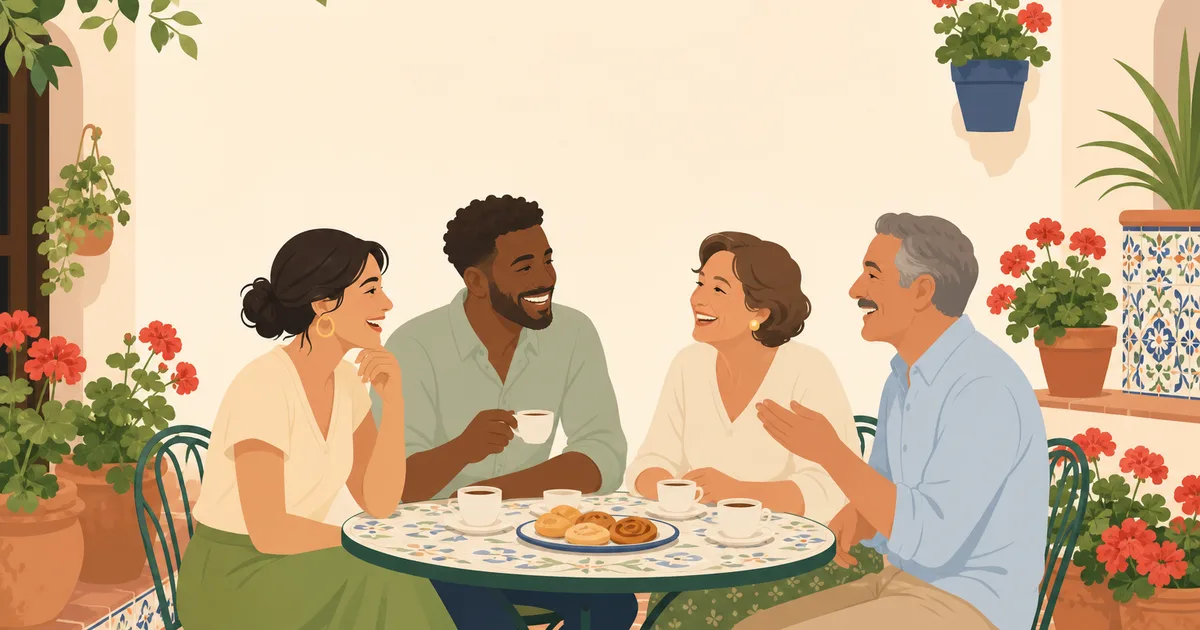
Whether the family lives in Madrid, Mexico City or Buenos Aires, meeting your partner's parents in Spanish usually means a long meal, many questions and at least one relative who insists you eat more. Spanish-speaking families are warm and direct, they touch, they interrupt, and they notice quickly whether you are making an effort in their language. You do not need fluent Spanish. You need a handful of phrases, the right choice between tú and usted, and the patience to stay at the table long after the plates are empty.
Below are thirty phrases with a reading hint for English speakers, followed by the etiquette Spanish-speaking families take for granted, what differs between Spain and Latin America, the most common mistakes and a two-week plan.
Key points
- Start with usted for each parent and ustedes for both, unless they tell you tutéame, "call me tú". In Spain that often happens within minutes; in much of Latin America usted lasts longer and is a sign of respect, not distance.
- Greetings are physical: a kiss on the cheek (two in Spain, one in most of Latin America) between women and between a man and a woman, a handshake or a hug between men.
- The meal does not end when the food does. The sobremesa, the long conversation after eating, is part of the visit; leaving straight away looks like you did not enjoy it.
Before the visit
- Ask your partner where the family is from and how formal it is. A Mexican grandmother and a Madrid father in his fifties expect different things.
- Bring something. Dessert, good chocolates, a bottle of wine or something typical of your country. Flowers for the mother are always welcome.
- Know the clock. In Spain lunch is around two or three in the afternoon and dinner after nine. Arriving ten or fifteen minutes late is normal almost everywhere; arriving early is not.
- Clear the afternoon or the evening. A family lunch can last until dark.
The 30 phrases
The hints use English spelling; capitals mark the stressed syllable. Spanish vowels are short and pure: a as in "father", e as in "bed", i as "ee", o as in "or", u as "oo". The j and a g before e or i sound like a rough h, the ñ like "ny" in "canyon", and the r is a quick tap, rolled when doubled. In most of Spain c before e or i and the z sound like "th" in "think"; in Latin America they are an s. A woman says encantada and llena instead of encantado and lleno. ○○ marks a name or a word to fill in.
Greetings and first words
| Spanish | Say it like | Meaning |
|---|---|---|
| ¡Buenas noches! | BWEH-nahs NOH-chehs | Good evening! Before dark: buenas tardes. |
| Mucho gusto, soy ○○. | MOO-choh GOOS-toh, soy ○○ | Nice to meet you, I'm ○○. |
| Encantado de conocerlos. | en-kahn-TAH-doh deh koh-noh-SEHR-lohs | Delighted to meet you both. |
| Gracias por invitarme. | GRAH-syahs por een-bee-TAHR-meh | Thank you for inviting me. |
| ○○ me ha hablado mucho de ustedes. | ○○ meh ah ah-BLAH-doh MOO-choh deh oos-TEH-dehs | ○○ has told me a lot about you. |
| ¡Por fin nos conocemos! | por FEEN nohs koh-noh-SEH-mohs | At last we meet! |
Polite forms and asking for help
| Spanish | Say it like | Meaning |
|---|---|---|
| Señora ○○, señor ○○ | seh-NYOH-rah ○○, seh-NYOHR ○○ | Mrs and Mr with the surname. In Mexico and elsewhere also doña and don with a first name. |
| Les traje un detalle. | lehs TRAH-heh oon deh-TAH-yeh | I brought you a little something. |
| Todavía estoy aprendiendo español. | toh-dah-BEE-ah ehs-TOY ah-pren-DYEN-doh ehs-pah-NYOHL | I'm still learning Spanish. |
| ¿Podría hablar un poco más despacio? | poh-DREE-ah ah-BLAHR oon POH-koh mahs dehs-PAH-syoh | Could you speak a little more slowly? |
| Perdone, ¿me lo puede repetir? | pehr-DOH-neh, meh loh PWEH-deh reh-peh-TEER | Sorry, could you repeat that? |
| ¿Cómo se dice esto en español? | KOH-moh seh DEE-seh EHS-toh en ehs-pah-NYOHL | How do you say this in Spanish? |
At the table
| Spanish | Say it like | Meaning |
|---|---|---|
| ¡Qué casa tan bonita! | keh KAH-sah tahn boh-NEE-tah | What a lovely home! |
| ¡Qué bien huele! | keh byen WEH-leh | That smells wonderful! |
| ¡Buen provecho! | bwen proh-BEH-choh | Enjoy your meal! In Spain also que aproveche. |
| ¡Está riquísimo! | ehs-TAH ree-KEE-see-moh | It's delicious! |
| ¿Me da la receta? | meh dah lah reh-SEH-tah | Would you give me the recipe? |
| ¿Puedo repetir? | PWEH-doh reh-peh-TEER | May I have seconds? |
| Estoy lleno, de verdad. Todo estaba buenísimo. | ehs-TOY YEH-noh, deh behr-DAHD. TOH-doh ehs-TAH-bah bweh-NEE-see-moh | I'm full, honestly. Everything was delicious. |
| ¿Le ayudo a recoger la mesa? | leh ah-YOO-doh ah reh-koh-HEHR lah MEH-sah | Can I help you clear the table? |
Small talk
| Spanish | Say it like | Meaning |
|---|---|---|
| Soy de ○○. | soy deh ○○ | I'm from ○○. |
| Trabajo como ○○. | trah-BAH-hoh KOH-moh ○○ | I work as ○○. |
| Me encanta la comida de aquí. | meh en-KAHN-tah lah koh-MEE-dah deh ah-KEE | I love the food here. |
| Nos conocimos en ○○. | nohs koh-noh-SEE-mohs en ○○ | We met in ○○. |
| ○○ es muy importante para mí. | ○○ ehs mwee eem-por-TAHN-teh PAH-rah mee | ○○ means a lot to me. |
Thanks and goodbye
| Spanish | Say it like | Meaning |
|---|---|---|
| Muchas gracias por todo. | MOO-chahs GRAH-syahs por TOH-doh | Thank you so much for everything. |
| Lo he pasado muy bien. | loh eh pah-SAH-doh mwee byen | I've had a wonderful time. In Latin America: la pasé muy bien. |
| Bueno, ya me tengo que ir. | BWEH-noh, yah meh TEHN-goh keh eer | Well, I have to go now. The start of a long goodbye. |
| Espero verlos pronto. | ehs-PEH-roh BEHR-lohs PROHN-toh | I hope to see you again soon. |
| ¡Hasta pronto! | AHS-tah PROHN-toh | See you soon! |
Etiquette Spanish-speaking families take for granted
- Greet everyone in the room. Kisses on the cheek, a hug or a handshake, but nobody is skipped, grandparents first. A general wave from the door looks cold.
- Food is affection. The cook will offer more, and more again. Try everything, take seconds and say what you liked; "I'm on a diet" is a small disappointment at any Spanish-speaking table.
- The sobremesa is sacred. After the meal comes coffee, sometimes a liqueur, and an hour of conversation. That is when the real getting-to-know-you happens.
- Loud and overlapping is normal. Interrupting and talking over each other is engagement. Jump in.
- "Mi casa es su casa" is meant warmly, and in Mexico you may hear it literally. Still, ask before you open the fridge.
- The goodbye takes time. Ya me tengo que ir starts it; then come one more coffee and a chat at the door.
Spain and Latin America
Spain moves to tú fast, eats late, and gives two kisses even at a first meeting; in Spain you will also hear vosotros instead of ustedes among family. Mexico and much of Central America keep usted longer, say provecho to people eating, and add con permiso when leaving the table. In Argentina and Uruguay people use vos instead of tú and a single kiss is common between men too. Words change as well: coche or carro, zumo or jugo. Ask your partner which Spanish the family speaks and learn their version of the phrases above.
Common mistakes
- Using tú with the parents uninvited in Latin America, or sticking to usted for hours in Spain after they have asked you to stop.
- False friends. Embarazada means pregnant, not embarrassed (that is avergonzado); estoy caliente is not "I'm warm" (say tengo calor); constipado in Spain means having a cold.
- Refusing food or leaving right after dessert. Stay for the sobremesa.
- Arriving early or exactly on time to a family lunch, while the hosts are still cooking.
- Assuming all Spanish-speaking countries are the same. Asking a Mexican family about flamenco, or an Argentinian one about tacos, lands badly.
A two-week practice plan
- Days 1–3: greetings. The first six phrases out loud every day, with the kisses or handshake your partner's family uses.
- Days 4–6: the table. Practise the food lines during real meals, including ¿Puedo repetir?
- Days 7–9: the questions. Prepare short answers about your work, your family, your country and how you met. Your partner plays the parents, using usted.
- Days 10–12: the whole visit. From the doorbell through the sobremesa to the long goodbye.
- Days 13–14: polish. Fix one sound per phrase, usually the r and the vowels, and choose the ten phrases you will definitely use.
How LinguaPair helps you get ready
LinguaPair is made for couples who live between two languages and want to speak both. You invite your partner and your two accounts become a pair: you follow your own Spanish course in short lessons, with the A0 and A1 levels free, and each of you sees the other's level and streak. Games against each other, translation duels and vocabulary races, are built from your words and turn the phrases above into a contest. On the day itself, the live translator works on one phone at the table: each person speaks their own language and every line is translated as you go, so the sobremesa becomes a real conversation instead of a string of polite nods. The words from those conversations land in your vocabulary trainer for the next visit. Games and unlimited translation come with Premium, and one subscription covers both of you.
Compare the same visit elsewhere: meeting French parents, Italian parents, Brazilian parents, Korean parents and Japanese parents. If a wedding is next, continue with a toast and vows in your partner's language, and see why te quiero is more common than te amo in how to say I love you in 10 languages.
For a German or a Vietnamese family, see 30 phrases for meeting German parents and 30 phrases for meeting Vietnamese parents.