 Lingua
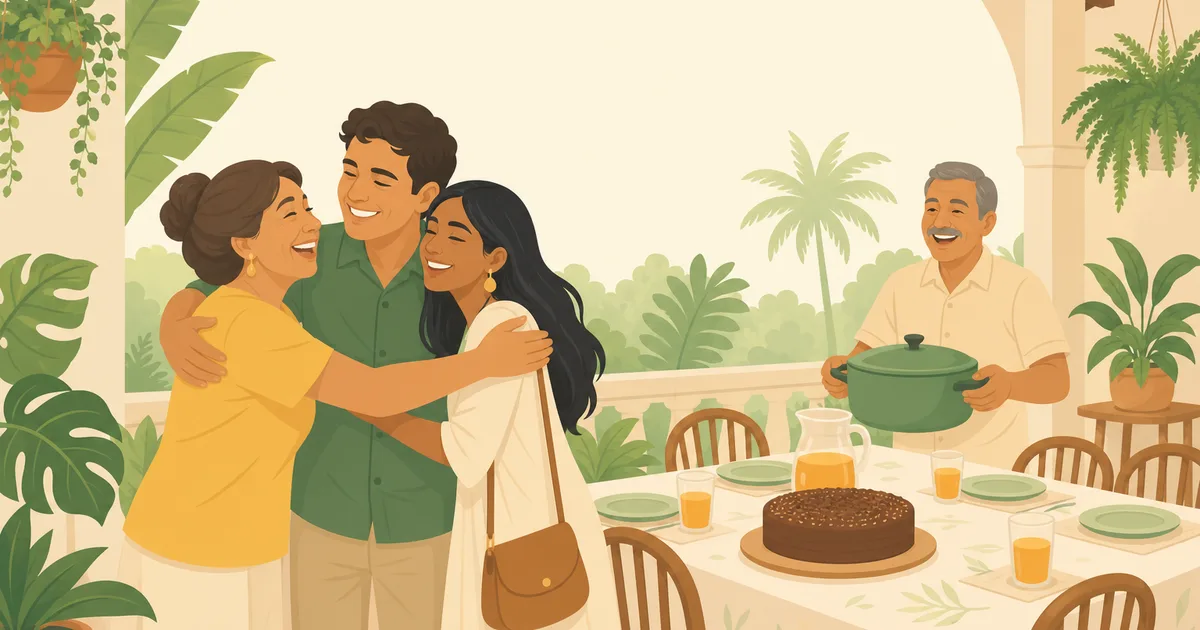
A Brazilian family rarely meets you at the door with a handshake. More likely it is a hug, a kiss on the cheek, a table already laid and someone asking whether you have eaten. The first visit to your partner's parents is warm almost by default, and what the parents notice is whether you give some of that warmth back, in their language. A few phrases, said with a smile and a little courage, open more doors than a perfect accent.
Below are thirty phrases in Brazilian Portuguese, with a reading hint for English speakers, followed by the etiquette Brazilian families take for granted, what changes if the family is from Portugal, the most common mistakes and a two-week plan.
Key points
- Warmth is expected in return: hugs, kisses on the cheek, compliments on the food, questions about the family. Reserve can read as coldness.
- Respect lives in small words: o senhor and a senhora ("sir", "madam") or Seu and Dona before a first name, until the parents tell you pode me chamar de você, "you can call me você".
- Food is how a Brazilian family says welcome. Accept, try everything and take seconds. In Portugal the code is similar but a notch more formal.
Before the visit
- Ask your partner how formal the family is. Many Brazilian parents switch to first names within minutes; others, especially older ones, like Seu Antônio and Dona Maria for a while.
- Bring something. A dessert, a box of chocolates, a bottle of wine or something typical of your country is perfect. Flowers for the mother are a classic.
- Relax about the clock. For a family lunch in Brazil, arriving fifteen to thirty minutes after the agreed time is normal; arriving early can catch the hosts unprepared. In Portugal, aim for close to on time.
- Clear the afternoon. A Sunday lunch can turn into coffee, dessert and dinner. Leaving straight after the meal looks like you did not enjoy it.
The 30 phrases
The hints follow Brazilian pronunciation; capitals mark the stressed syllable. Three things matter most. Final -e sounds like "ee", and te and de become "chee" and "jee", so noite is "NOY-chee". Vowels before m and n, and the ending -ão, are nasal: let the sound go through your nose. An initial r and a double rr sound like the English h, and a final l sounds like w, so Brasil is "brah-ZEEW". Men say obrigado, women say obrigada; the word agrees with the speaker. ○○ marks a name or a word to fill in.
Greetings and first words
| Portuguese | Say it like | Meaning |
|---|---|---|
| Boa noite! Tudo bem? | BOH-ah NOY-chee! TOO-doo bayn? | Good evening! How are you? |
| Muito prazer! | MWEEN-too prah-ZEHR | Very nice to meet you. |
| Eu sou o ○○ / a ○○. | EH-oo SOH oo / ah ○○ | I'm ○○. Brazilians put o or a before a name. |
| É um prazer finalmente conhecer vocês. | EH oong prah-ZEHR fee-now-MEN-chee koh-nyeh-SEHR voh-SEHS | It's a pleasure to finally meet you both. |
| O ○○ fala muito de vocês. | oo ○○ FAH-lah MWEEN-too jee voh-SEHS | ○○ talks about you a lot. A for a woman: a ○○. |
| Obrigado pelo convite. | oh-bree-GAH-doo PEH-loo kohn-VEE-chee | Thank you for inviting me. |
Respect and asking for help
| Portuguese | Say it like | Meaning |
|---|---|---|
| Seu ○○, Dona ○○ | SEH-oo ○○, DOH-nah ○○ | Mr and Mrs with a first name: the warm respectful way to address older people. |
| Trouxe uma lembrancinha pra vocês. | TROH-see OO-mah lem-brahn-SEE-nyah prah voh-SEHS | I brought you a little something. |
| Ainda estou aprendendo português. | ah-EEN-dah ees-TOH ah-pren-DEN-doo por-too-GEHS | I'm still learning Portuguese. |
| Vocês podem falar mais devagar? | voh-SEHS POH-dayn fah-LAHR mize jee-vah-GAHR | Could you speak more slowly? |
| Desculpa, pode repetir? | jees-KOO-pah, POH-jee heh-peh-CHEER | Sorry, could you say that again? |
| Com licença. | kohn lee-SEN-sah | Excuse me: to pass, to enter, to leave the table. |
At the table
| Portuguese | Say it like | Meaning |
|---|---|---|
| Que casa linda! | kee KAH-zah LEEN-dah | What a lovely home! |
| Que cheiro bom! | kee SHAY-roo bohn | That smells wonderful! |
| Está uma delícia! | ees-TAH OO-mah deh-LEE-see-ah | It's delicious! |
| Foi a senhora que fez? | foy ah seen-YOH-rah kee fess | Did you make it yourself? |
| Posso repetir? | POH-soo heh-peh-CHEER | May I have seconds? Repetir means "take more". |
| Me passa o ○○, por favor? | mee PAH-sah oo ○○, poor fah-VOHR | Could you pass me the ○○, please? |
| Estou satisfeito, obrigado. | ees-TOH sah-chees-FAY-too, oh-bree-GAH-doo | I'm full, thank you. Women: satisfeita, obrigada. |
| Posso ajudar com a louça? | POH-soo ah-zhoo-DAHR kohn ah LOH-sah | Can I help with the dishes? |
Small talk
| Portuguese | Say it like | Meaning |
|---|---|---|
| Eu sou de ○○. | EH-oo SOH jee ○○ | I'm from ○○. |
| Eu trabalho com ○○. | EH-oo trah-BAH-lyoo kohn ○○ | I work in ○○. |
| Estou adorando o Brasil. | ees-TOH ah-doh-RAHN-doo oo brah-ZEEW | I'm loving Brazil. |
| Como se diz isso em português? | KOH-moo see jeez EE-soo ayn por-too-GEHS | How do you say this in Portuguese? |
| O ○○ é muito especial pra mim. | oo ○○ EH MWEEN-too ees-peh-see-OW prah meeng | ○○ is very special to me. |
Thanks and goodbye
| Portuguese | Say it like | Meaning |
|---|---|---|
| Muito obrigado por tudo. | MWEEN-too oh-bree-GAH-doo poor TOO-doo | Thank you so much for everything. |
| Foi um prazer conhecer vocês. | foy oong prah-ZEHR koh-nyeh-SEHR voh-SEHS | It was a pleasure to meet you. |
| A gente se vê de novo logo, né? | ah ZHEN-chee see VEH jee NOH-voo LOH-goo, neh | We'll see each other again soon, right? |
| Bom, já vou indo. | bohn, zhah voh EEN-doo | Well, I'll be going. The start of a Brazilian goodbye. |
| Até a próxima! | ah-TEH ah PROH-see-mah | Until next time! |
Etiquette Brazilian families take for granted
- Greet everyone, one by one. A hug and a kiss on the cheek are normal, even at a first meeting: one kiss in São Paulo, often two in Rio, and the father may prefer a handshake and a pat on the shoulder. Follow their lead and do not skip anyone in the room, grandparents first.
- "Fica à vontade" means it. "Make yourself at home" is meant literally. Sit down, accept the drink, take your shoes off only if they do.
- The food keeps coming. The mother or grandmother will insist, and saying no once is part of the game. Taking seconds is the best compliment, and leftovers wrapped for you to take home are a sign of affection.
- Loud and overlapping is good. People talk at the same time, interrupt and laugh over each other. It is engagement, not rudeness; jump in.
- The goodbye takes a while. Já vou indo starts it, then come more coffee, more stories and a last chat at the door. Budget half an hour from the first "I should go".
- Watch two hand gestures. The thumbs-up is everywhere and friendly, but the "OK" sign made with thumb and index finger is an insult in Brazil.
If the family is from Portugal
Portuguese families are just as warm but more reserved at the start. Greetings are usually two kisses on the cheek between women and between a man and a woman, a handshake between men. O senhor and a senhora last longer, and você said straight to an older person can sound abrupt, so use their title or name instead. Punctuality matters more. Grammar shifts too: estou a aprender rather than estou aprendendo, passa-me o sal rather than me passa o sal, uma lembrança rather than lembrancinha, conhecemo-nos em ○○ for "we met in". Pronunciation is the biggest change: unstressed vowels almost disappear, te and de stay "teh" and "deh", and a final s sounds like "sh". Ask your partner to record a few lines in the family's own accent.
Common mistakes
- Speaking Spanish and hoping for the best. Brazilians understand some, but a Portuguese "obrigado" lands far better than "gracias", and Brazil is not a Spanish-speaking country.
- Getting obrigado or obrigada wrong. It agrees with you, the speaker, not with the person you thank.
- Turning food down. "I'm on a diet" at a Brazilian lunch is a small heartbreak; take a little of everything instead.
- Leaving right after the meal. Stay for coffee and dessert at the very least.
- Arriving empty-handed or exactly on time to a big family lunch, when the hosts are still in the kitchen.
A two-week practice plan
- Days 1–3: greetings. Say the first six phrases aloud every day and record them; focus on the nasal sounds.
- Days 4–6: the table. Practise the food lines with your partner during real meals at home, including posso repetir?
- Days 7–9: the questions. Prepare short answers about your work, your family, your country and how you met. Your partner plays the parents.
- Days 10–12: the whole visit. Role-play from the doorbell through the long goodbye.
- Days 13–14: polish. Fix one sound per phrase and choose the ten you will definitely use.
How LinguaPair helps you get ready
LinguaPair is built around one idea: you learn your partner's language, and they learn yours. You invite your partner and your two accounts become a pair: you follow your own Portuguese course in short lessons, with the A0 and A1 levels free, and each of you sees the other's level and streak. Games against each other, translation duels and vocabulary races, are built from your words and turn the phrases above into a contest. On the day itself, the live translator works on one phone at the table: each person speaks their own language and every line is translated as you go, so the parents can ask what they really want to know and you can join the noisy, happy conversation. The words from those conversations land in your vocabulary trainer for the next lunch. Games and unlimited translation come with Premium, and one subscription covers both of you.
The same visit looks very different elsewhere: compare meeting Korean parents, meeting Japanese parents and meeting Italian parents. If a wedding is next, continue with a toast and vows in your partner's language, and for the three words that come first, see how to say I love you in 10 languages.
For a Spanish-speaking or a French family, see 30 phrases for meeting Spanish-speaking parents and 30 phrases for meeting French parents.