 Lingua
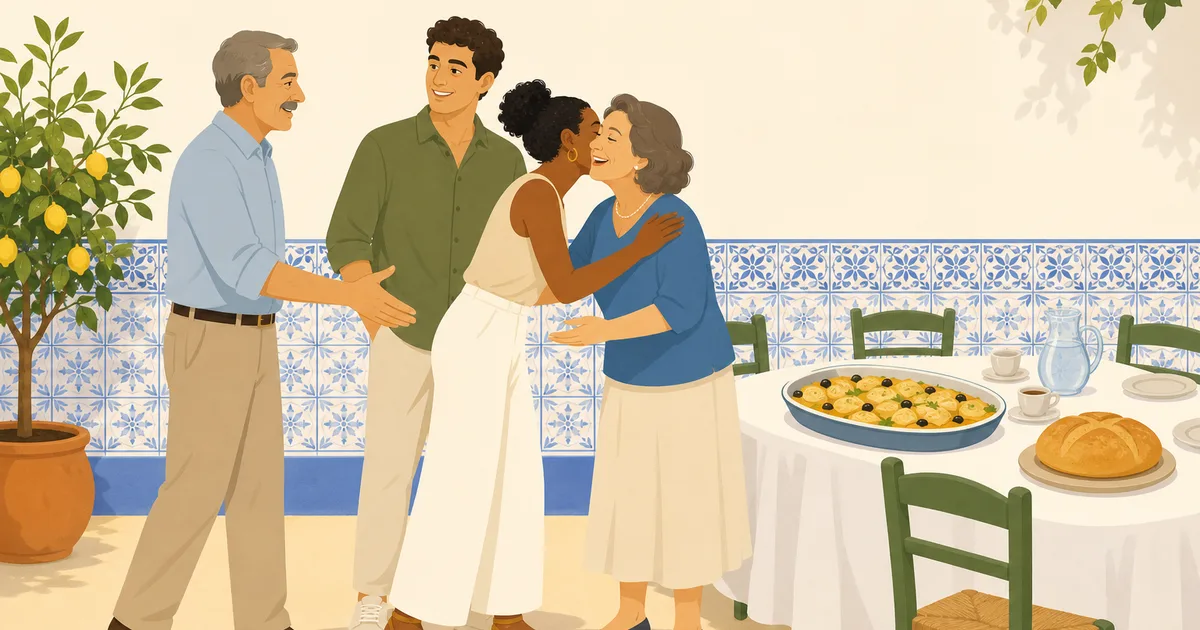
A Portuguese family is warm, but it takes its time. At the door you are likely to get two kisses on the cheek and a polite muito prazer, and then a table that keeps filling up while the parents quietly work out who you are. The first visit is often a long Sunday lunch, and what they notice is small: how you address them, whether you eat with pleasure, whether you tried their language. A few phrases, said with care, do more than a perfect accent.
Below are thirty phrases in European Portuguese, the Portuguese of Portugal, with a reading hint for English speakers. After them come the etiquette Portuguese families take for granted, what differs if your Portuguese comes from Brazil, the most common mistakes and a two-week plan. Families vary by region and generation, so read all of this as tendencies, and let your partner correct it for theirs.
Key points
- How you address the parents is the first thing they hear. Start with o senhor and a senhora, or Senhor and Dona before a first name, with the verb in the third person, until they tell you trata-me por tu. A bare você said to an older person can sound abrupt in Portugal, so most people go around it.
- Let the parents lead the greeting. Two kisses between women and between a man and a woman, a handshake between men: that is the usual pattern, and the older person decides.
- Lunch is the event. Try everything, accept a little more when they insist, offer to help and stay for the coffee.
Before the visit
- Ask your partner how the family speaks to each other. Some parents move to tu within the hour, others keep the formal forms for a long time. Ask what your partner's friends call them, and whether anyone uses a title.
- Bring something. A bottle of wine, good chocolates, a box of cakes from a pastelaria or something from your own country all work. Flowers for the mother are welcome; skip chrysanthemums, which many people associate with cemeteries.
- Be on time, or close to it. For a meal at home, the agreed time or ten to fifteen minutes after is the usual range. Arriving early can catch the hosts still cooking. If your partner says the family runs late, believe them.
- Keep the afternoon free. A Sunday lunch can run from soup to coffee and well into the afternoon, and leaving straight after the meal looks as if you did not enjoy it.
The 30 phrases
The hints follow the pronunciation of Portugal; capitals mark the stressed syllable. Three things matter most. Unstressed vowels almost vanish, and an apostrophe marks one that does: desculpe is "d'sh-KOOLP". An s at the end of a word or before a consonant sounds like sh: está is "shTAH". And te and de stay short, "t'" and "d'", never "chee" or "jee". Vowels before m and n, and the ending -ão, are nasal, and an r at the start of a word is a rough sound in the throat. Men say obrigado and women obrigada: the word agrees with the speaker. ○○ marks a name or a word to fill in.
Greetings and first words
| Portuguese | Say it like | Meaning |
|---|---|---|
| Boa tarde! Como está? | BOH-uh TARD! KOH-moo shTAH? | Good afternoon! How are you? Before lunch, say bom dia. The verb in the third person is the polite form. |
| Muito prazer! | MWEEN-too pruh-ZEHR | Very nice to meet you. |
| Sou o ○○ / a ○○. | SOH oo ○○ / uh ○○ | I'm ○○. In Portugal a name usually takes o or a. |
| Tenho muito gosto em conhecê-los. | TEH-nyoo MWEEN-too GOHSH-too ayn koo-nyuh-SEH-loosh | I'm very pleased to meet you. Said to both parents. |
| O ○○ fala-me muito da família. | oo ○○ FAH-luh-m MWEEN-too duh fuh-MEE-lyuh | ○○ often tells me about the family. For a woman: a ○○. |
| Obrigado pelo convite. | oh-bree-GAH-doo PEH-loo kohn-VEET | Thank you for inviting me. Women say obrigada. |
Forms of address and asking for help
| Portuguese | Say it like | Meaning |
|---|---|---|
| Senhor ○○, Dona ○○ | s'-NYOHR ○○, DOH-nuh ○○ | Mr and Mrs with a first name: the respectful everyday way to address older people. |
| Trouxe-lhes uma lembrança. | TROH-s-lyush OO-muh lem-BRAHN-suh | I brought you a little something. |
| Ainda estou a aprender o português de cá. | uh-EEN-duh shTOH uh uh-pren-DEHR oo poor-too-GEHSH d' KAH | I'm still learning the Portuguese spoken here. |
| Pode falar um bocadinho mais devagar, por favor? | POD fuh-LAHR oong boo-kuh-DEE-nyoo mysh d'-vuh-GAHR, poor fuh-VOHR | Could you speak a little more slowly, please? |
| Desculpe, pode repetir? | d'sh-KOOLP, POD rr'-p'-TEER | Sorry, could you say that again? |
| Como é que se chama isto? | KOH-moo EH k' s' SHUH-muh EESH-too | What's this called? |
At the table
| Portuguese | Say it like | Meaning |
|---|---|---|
| Que casa tão bonita! | k' KAH-zuh towng boo-NEE-tuh | What a lovely home! |
| Cheira muito bem! | SHAY-ruh MWEEN-too bayng | That smells wonderful! |
| Está uma delícia! | shTAH OO-muh d'-LEE-syuh | It's delicious! |
| Foi a senhora que fez? | foy uh s'-NYOH-ruh k' FESH | Did you make it yourself? To a man: foi o senhor. |
| Só mais um bocadinho, se faz favor. | SAW mysh oong boo-kuh-DEE-nyoo, s' fash fuh-VOHR | Just a little more, please. |
| Pode passar-me o ○○, se faz favor? | POD puh-SAHR-m' oo ○○, s' fash fuh-VOHR | Could you pass me the ○○, please? For a feminine word: a ○○. |
| Já estou satisfeito, obrigado. | zhah shTOH suh-teesh-FAY-too, oh-bree-GAH-doo | I'm full, thank you. Women: satisfeita, obrigada. |
| Posso ajudar a levantar a mesa? | POSS-oo uh-zhoo-DAHR uh l'-vahn-TAHR uh MEH-zuh | Can I help clear the table? |
Small talk
| Portuguese | Say it like | Meaning |
|---|---|---|
| Sou de ○○. | SOH d' ○○ | I'm from ○○. |
| Trabalho em ○○. | truh-BAH-lyoo ayn ○○ | I work in ○○. |
| Estou a gostar muito de Portugal. | shTOH uh goosh-TAHR MWEEN-too d' poor-too-GAHL | I'm really enjoying Portugal. |
| Conhecemo-nos em ○○. | koo-nyuh-SEH-moo-noosh ayn ○○ | We met in ○○. |
| O ○○ é muito especial para mim. | oo ○○ EH MWEEN-too shp'-SYAHL PAH-ruh meeng | ○○ is very special to me. For a woman: a ○○. |
Thanks and goodbye
| Portuguese | Say it like | Meaning |
|---|---|---|
| Muito obrigado por tudo. | MWEEN-too oh-bree-GAH-doo poor TOO-doo | Thank you so much for everything. Women: muito obrigada. |
| Foi um prazer conhecê-los. | foy oong pruh-ZEHR koo-nyuh-SEH-loosh | It was a pleasure to meet you. |
| Está a ficar tarde, temos de ir andando. | shTAH uh fee-KAHR TARD, TEH-moosh d' EER ahn-DAHN-doo | It's getting late, we'd better be going. The polite way to start leaving. |
| Espero vê-los em breve. | shPEH-roo VEH-loosh ayn BREV | I hope to see you again soon. |
| Até à próxima! | uh-TEH ah PRAW-see-muh | Until next time! |
Etiquette Portuguese families take for granted
- The greeting follows the older person. Two kisses, one on each cheek and more touch than sound, are usual between women and between a man and a woman; men usually shake hands, and close family may add a hug. At a first meeting, wait a moment: an offered hand means a handshake, a leaning cheek means kisses. Greet everyone in the room, grandparents first.
- Address comes in steps. Tu is for family and friends. Respect is the third person: o senhor, a senhora, Senhor António, Dona Maria, or the verb alone, as in como está? Dona goes with the first name, not the surname. When the parents say trata-me por tu, take them up on it.
- Titles can be real. Senhor Doutor and Senhora Doutora for someone with a degree, Senhor Engenheiro for an engineer: these are commoner at work than at home, but some people of the older generation use them socially. Your partner will know whether a parent expects one.
- Sunday lunch has a rhythm. Often several generations at one table, soup, a main dish such as bacalhau or a roast, dessert and then um café. Wait until the hosts start or someone says bom apetite.
- Offer to help, and accept the answer. Posso ajudar a levantar a mesa? counts even if the answer is no, and on a first visit it often is. Do not walk into the kitchen uninvited.
- Praise the food while you eat it. Está uma delícia! and foi a senhora que fez? open a conversation about the recipe. They may insist on a second helping; a small one is the easy answer, and já estou satisfeito is the polite way to stop.
- Conversation warms up slowly. Questions about your family, your work and your plans are normal. Football may come up; asking which club they follow is safer than taking a side.
If your Portuguese comes from Brazil
It is one language with two sets of habits, and neither is the correct one. The parents will understand Brazilian Portuguese and most will enjoy your effort, but you will hear something different from what you learned. People say estou a aprender rather than estou aprendendo, passa-me rather than me passa, and conhecemo-nos rather than a gente se conheceu. Everyday words change too: telemóvel, pequeno-almoço, casa de banho. The greatest difference is in the ear, because unstressed vowels fall away, so ask your partner to speak slowly at first. For the other side of the same visit, see meeting Brazilian parents.
Common mistakes
- Using você or first names too soon. Stay with o senhor, a senhora or Dona Maria until you are invited to change.
- Speaking Spanish and hoping for the best. Many Portuguese understand it, but obrigado lands far better than gracias, and Portugal is not a region of Spain.
- Getting obrigado or obrigada wrong. It agrees with you, the speaker, not with the person you thank.
- Turning food down outright. If you have an allergy or a dietary rule, tell your partner beforehand so the family can plan. A small portion is better than a firm no.
- Leaving right after the meal. Stay for dessert and coffee at the very least.
- Arriving early or empty-handed. Neither is a disaster, but both are easy to avoid.
A two-week practice plan
- Days 1–3: the door. Say the first six phrases aloud every day and record them. Listen for the vowels you can let go.
- Days 4–6: the table. Practise the food lines during real meals at home, including só mais um bocadinho, se faz favor.
- Days 7–9: the questions. Prepare short answers about your work, your family, your country and how you met. Your partner plays the parents and you answer in the third person.
- Days 10–12: the whole visit. Role-play from the doorbell to está a ficar tarde, kisses and coffee included.
- Days 13–14: polish. Fix one sound per phrase and choose the ten you will definitely use.
How LinguaPair helps you get ready
LinguaPair is built around one idea: you learn your partner's language, and they learn yours. You invite your partner and your two accounts become a pair: you follow your own course in European Portuguese in short lessons, with the A0 and A1 levels free, and each of you sees the other's level and streak. The course teaches the Portuguese of Portugal and is separate from the Brazilian one, so choose the one your partner's family speaks. Games against each other, translation duels and vocabulary races, are built from your words and turn the phrases above into a contest. On the day itself, the live translator works on one phone at the table: each person speaks their own language and every line is translated as you go, so the parents can ask what they really want to know and you can answer with more than a smile. The words from those conversations land in your vocabulary trainer for the next lunch. Games and unlimited translation come with Premium, and one subscription covers both of you.
The same visit looks different elsewhere: compare meeting Spanish-speaking parents and meeting Italian parents. If a wedding is next, continue with a toast and vows in your partner's language, and for the three words that come first, see how to say I love you in your partner's language.