 Lingua
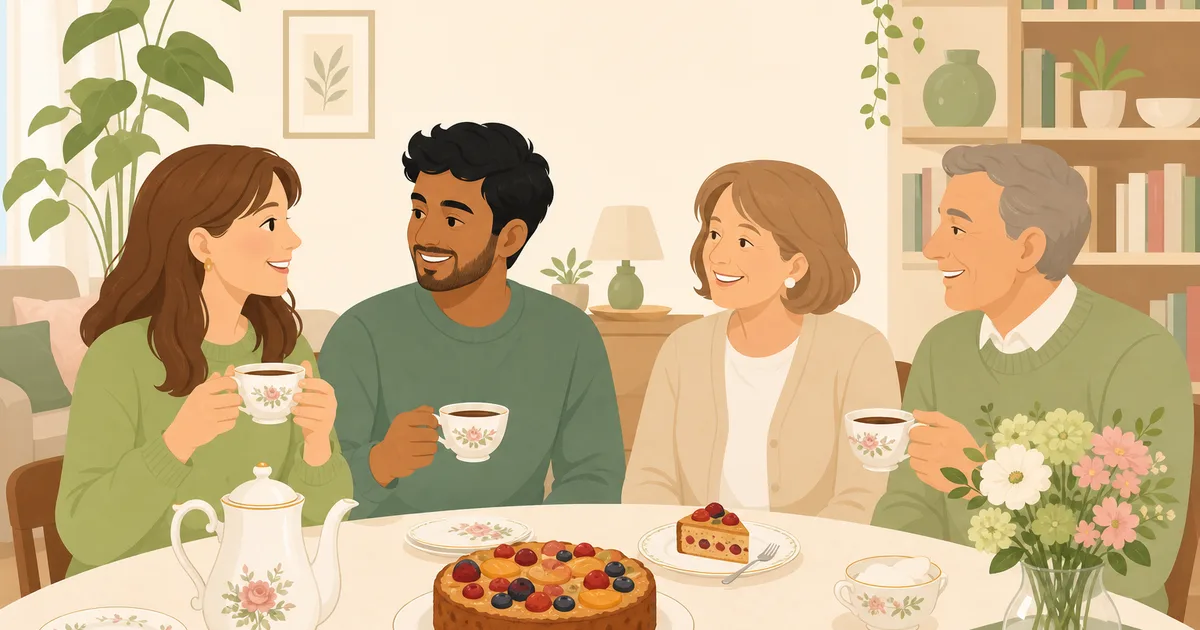
The first visit to your partner's parents in Germany is often not a dinner at all but Kaffee und Kuchen: coffee and homemade cake on a Saturday or Sunday afternoon, around three o'clock, at a table set with the good china. German parents tend to be friendly but reserved at first, and they value a few things more than charm: arriving on time, a firm handshake, the polite Sie, and meaning what you say. Get those right and a dozen German phrases will carry you a long way.
Below are thirty phrases with a reading hint for English speakers, followed by the etiquette German families take for granted, what changes in Austria and Switzerland, the most common mistakes and a two-week plan.
Key points
- Shake hands with each person, look them in the eye and say Guten Tag or Guten Abend with Frau or Herr and the surname: Frau Becker, Herr Becker. Use Sie until the parents offer du, usually with a sentence like Wir können uns gern duzen.
- Be on time. Not roughly on time: on time. Five minutes late deserves a message, and fifteen minutes early is awkward too.
- Say what you mean. A German host takes Nein, danke at face value and will not ask three times, so if you want another slice of cake, say yes the first time.
Before the visit
- Ask your partner how the family works. A Berlin family that says du within an hour and a Bavarian family that keeps Sie for months are both normal. Ask whether the parents are likely to offer du, and when.
- Bring something small. Flowers, good chocolates, a bottle of wine or a speciality from your own country all work. Flowers are traditionally unwrapped before you hand them over; avoid red roses, which are for lovers, and white lilies or chrysanthemums, which belong at funerals.
- Check the time and the meal. Kaffee und Kuchen is a meal in itself. If you are invited for the evening, dinner may be Abendbrot, a cold supper of bread, cheese and cold cuts, often around six or seven, because the warm meal was at lunch.
- Ask about shoes. Many German homes are shoes-off, and the hosts may offer Hausschuhe, slippers. Good socks are part of the outfit.
The 30 phrases
The hints use English spelling, with the stressed syllable in capitals. "Kh" is the soft hiss of ich or the throaty sound of Bach; "ö" is the vowel of "her" said with rounded lips, and "ü" is "ee" with rounded lips. The German r is soft and throaty, often almost silent at the end of a word, and a final d or b sounds like t or p. "Zee" for Sie starts with a buzzing z. ○○ marks a name or a word to fill in.
Greetings and first words
| German | Say it like | Meaning |
|---|---|---|
| Guten Abend, Frau ○○! Guten Abend, Herr ○○! | GOO-ten AH-bent, frow ○○! GOO-ten AH-bent, hair ○○! | Good evening, Mrs ○○, Mr ○○, with the surname. Before evening: Guten Tag. |
| Freut mich sehr, Sie kennenzulernen. | froyt mikh zair, zee KEN-en-tsoo-ler-nen | Very pleased to meet you. |
| Ich bin ○○. | ikh bin ○○ | I'm ○○. |
| Vielen Dank für die Einladung. | FEE-len dahnk für dee AIN-lah-doong | Thank you very much for the invitation. |
| ○○ hat mir schon viel von Ihnen erzählt. | ○○ hat meer shohn feel fon EE-nen er-TSAYLT | ○○ has told me a lot about you. |
| Schön, dass wir uns endlich kennenlernen. | shöön, dahs veer oons ENT-likh KEN-en-ler-nen | It's lovely that we're finally meeting. |
Polite forms and asking for help
| German | Say it like | Meaning |
|---|---|---|
| Das ist eine Kleinigkeit für Sie. | dahs ist AI-ne KLAI-nikh-kait für zee | This is a little something for you. |
| Soll ich die Schuhe ausziehen? | zol ikh dee SHOO-e OWS-tsee-en | Should I take my shoes off? |
| Ich lerne noch Deutsch. | ikh LER-ne nokh doytch | I'm still learning German. |
| Könnten Sie bitte etwas langsamer sprechen? | KÖN-ten zee BIT-te ET-vahs LAHNG-zah-mer SHPRE-khen | Could you speak a little more slowly, please? |
| Entschuldigung, wie bitte? | ent-SHOOL-dee-goong, vee BIT-te | Sorry, could you say that again? |
| Wie sagt man das auf Deutsch? | vee zahkt mahn dahs owf doytch | How do you say that in German? |
Coffee, cake and dinner
| German | Say it like | Meaning |
|---|---|---|
| Der Kuchen sieht toll aus! | der KOO-khen zeet tol ows | The cake looks wonderful! |
| Haben Sie ihn selbst gebacken? | HAH-ben zee een zelpst ge-BAH-ken | Did you bake it yourself? |
| Guten Appetit! | GOO-ten ah-pe-TEET | Enjoy your meal! |
| Prost! Zum Wohl! | prohst! tsoom vohl | Cheers! The second is a little more formal, often with wine. |
| Das schmeckt wirklich sehr gut. | dahs shmekt VEERK-likh zair goot | This tastes really good. |
| Ja, gern noch ein Stück. | yah, gern nokh ain shtük | Yes, I'd love another piece. |
| Danke, ich bin satt. Es war köstlich. | DAHN-ke, ikh bin zaht. es vahr KÖST-likh | Thank you, I'm full. It was delicious. |
| Kann ich beim Abräumen helfen? | kahn ikh baim AHP-roy-men HEL-fen | Can I help clear the table? |
Small talk
| German | Say it like | Meaning |
|---|---|---|
| Sie haben es sehr schön hier. | zee HAH-ben es zair shöön heer | You have a lovely home. |
| Ich komme aus ○○. | ikh KOM-me ows ○○ | I'm from ○○. |
| Ich arbeite als ○○. | ikh AR-bai-te ahls ○○ | I work as a ○○. |
| Wir haben uns in ○○ kennengelernt. | veer HAH-ben oons in ○○ KEN-en-ge-lernt | We met in ○○. |
| ○○ bedeutet mir sehr viel. | ○○ be-DOY-tet meer zair feel | ○○ means a lot to me. |
Thanks and goodbye
| German | Say it like | Meaning |
|---|---|---|
| Vielen Dank für alles. | FEE-len dahnk für AH-les | Thank you for everything. |
| Es war ein sehr schöner Abend. | es vahr ain zair SHÖÖ-ner AH-bent | It's been a lovely evening. |
| Wir müssen uns langsam auf den Weg machen. | veer MÜ-sen oons LAHNG-zahm owf den vayk MAH-khen | We should slowly be on our way. |
| Ich hoffe, wir sehen uns bald wieder. | ikh HOF-fe, veer ZAY-en oons bahlt VEE-der | I hope we'll see each other again soon. |
| Auf Wiedersehen und nochmals danke! | owf VEE-der-zayn oont NOKH-mahls DAHN-ke | Goodbye, and thanks again! |
Etiquette German families take for granted
- Handshakes, eye contact, surnames. Greet each person separately, starting with the mother, and look at them while you shake hands. Hugs come later, and only if they start them.
- Sie until du is offered. The older person offers du, usually with Sag doch du or Wir können uns gern duzen. Accept with Gern, ich bin ○○. In some families this comes with a glass of wine and a toast.
- Eye contact when you clink glasses. Look each person in the eye as your glasses touch. Germans joke that skipping it brings seven years of bad luck in bed, and some of them only half joke.
- Guten Appetit before the first bite. Wait until the host says it or starts eating.
- No means no, yes means yes. Hosts will offer once, perhaps twice. Refusing out of modesty may leave you hungry.
- Honest compliments. Praise the cake specifically, the crumble on top, the plums. Germans dislike flattery that sounds empty.
- Topics. Travel, work, hobbies, your country, football and the weather are all fine; money and income are not.
Austria and Switzerland
In Austria and Bavaria you will hear Grüß Gott instead of Guten Tag, and Servus among friends. Austrians use academic titles more: a parent with a doctorate may be Frau Doktor or Herr Doktor even at home, so listen to how your partner introduces them. The afternoon cake is a Jause, with Schlagobers, whipped cream. In German-speaking Switzerland, the greeting is Grüezi, merci is the everyday thank you and En Guete is said before the meal. At home many Swiss families speak Swiss German, which is very different from standard German; most will switch to Hochdeutsch for you if you ask kindly. Swiss punctuality is, if anything, stricter.
Common mistakes
- Saying du before you are invited to. Wait for the offer, then use it every time.
- Saying Ich bin voll to mean "I'm full". It means "I'm drunk". Say Ich bin satt.
- Trusting false friends. Gift is poison, bekommen means to get, not to become, and Handy is a mobile phone.
- Arriving late without a message, or arriving very early and catching the hosts in the middle of their preparations.
- Refusing everything politely, expecting to be asked again.
- Asking how much things cost or what someone earns.
A two-week practice plan
- Days 1–3: the doorway. Guten Abend, Frau ○○, Freut mich sehr, Ich bin ○○, with a real handshake and eye contact.
- Days 4–6: the table. Practise Der Kuchen sieht toll aus, Das schmeckt wirklich sehr gut and Ich bin satt during real meals; work on ö and ü.
- Days 7–9: the questions. Prepare short answers about your work, your family, your country and how you met. Your partner plays the parents, using Sie.
- Days 10–12: the whole visit. From the doorbell to Wir müssen uns langsam auf den Weg machen, including the moment they offer du.
- Days 13–14: polish. Fix one sound per phrase, usually the ch and the ü, and choose the ten phrases you will definitely use.
How LinguaPair helps you get ready
LinguaPair is made for bilingual couples who learn each other's languages. You invite your partner and your two accounts become a pair: you follow your own German course in short lessons, with the A0 and A1 levels free, and each of you sees the other's level and streak. Games against each other, translation duels and vocabulary races, are built from your words and turn the phrases above into a contest. On the day itself, the live translator works on one phone at the table: each person speaks their own language and every line is translated as you go, so you can follow the conversation over coffee instead of guessing. The words from those conversations land in your vocabulary trainer for the next visit. Games and unlimited translation come with Premium, and one subscription covers both of you.
Compare the same visit elsewhere: meeting French parents, Spanish-speaking parents, Italian parents, Brazilian parents, Korean parents and Japanese parents. If a wedding is next, continue with a toast and vows in your partner's language, and for the first words of love, how to say I love you in 10 languages.
For a Russian-speaking family, see 30 phrases for meeting Russian parents; and if your foreign partner is the one meeting your parents, read which English phrases to teach them.