 Lingua
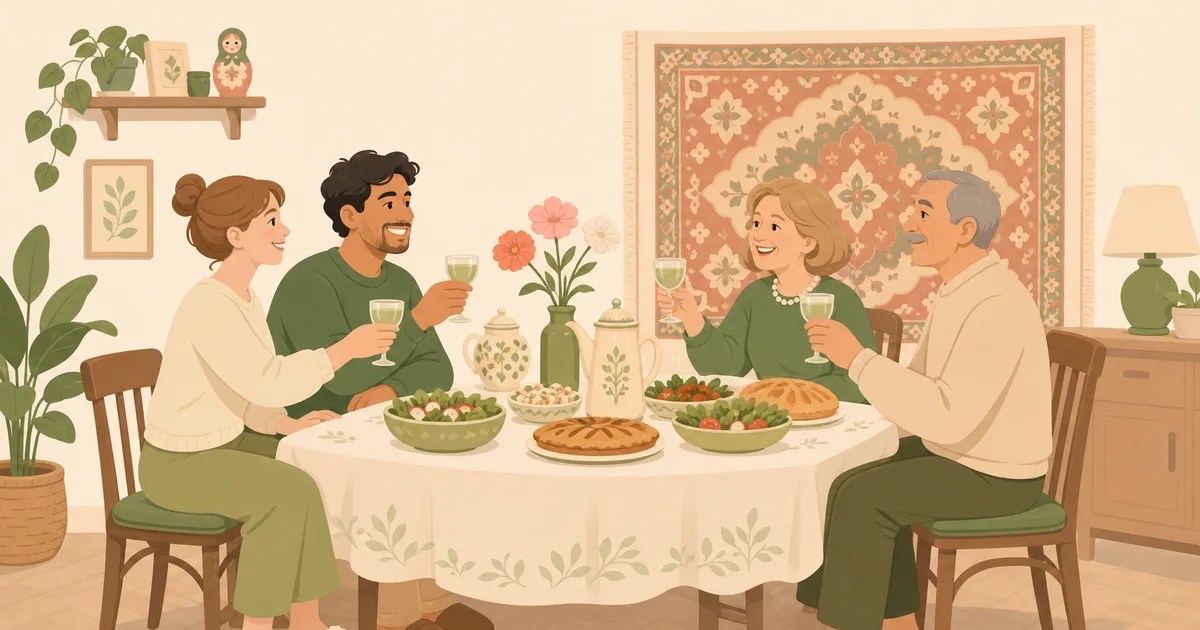
Meeting your partner's parents in a Russian-speaking family usually means a table. Not a dinner in the Western sense, but a застолье: the table is already covered with salads, pickles and cold dishes when you arrive, a hot course follows, then tea with cake, and in between come toasts, stories and questions. Russian parents can look serious at first, because people in Russia do not smile at strangers out of politeness, but the hospitality is enormous. What they notice is respect: the polite вы, the right form of address, a gift in your hands, and your willingness to eat, listen and say a toast.
Below are thirty phrases with a reading hint for English speakers, followed by the etiquette Russian families take for granted, notes on Russian-speaking families outside Russia, the most common mistakes and a two-week plan.
Key points
- Use вы, the polite "you", until the parents suggest ты. Older Russians are addressed by first name and patronymic, the father's name with an ending: Ольга Ивановна, Сергей Петрович. Ask your partner for both names in advance, or simply ask Как к вам лучше обращаться?, "How should I address you?".
- Never arrive empty-handed. Flowers for the mother, in an odd number, and something for the table, a cake or chocolates, are the classic gifts.
- Expect to be fed, and to be asked twice. A single polite "no" is not believed; eat a little of everything and praise the hostess.
Before the visit
- Learn the names. First name and patronymic for each parent, and whether the family is likely to switch to first names quickly. Younger parents may say просто Оля, "just Olya", within an hour.
- Choose the flowers carefully. An odd number of stems, never an even one: even numbers are for funerals. Roses, tulips or a mixed bouquet are safe. Hand them over unwrapped from the cellophane if you can.
- Bring something for the table. A cake, good chocolates, a bottle of wine or brandy for the father, or a speciality from your country. Something for a younger sibling is a warm touch.
- Do not eat beforehand. You will be offered far more food than you think, and starting the evening hungry is the best compliment.
- Bring good socks. You will take your shoes off at the door and be given тапочки, slippers.
The 30 phrases
The hints use English spelling, with the stressed syllable in capitals; Russian stress is strong and unpredictable, so learn it with each word. Unstressed "o" sounds like "a", which is why спасибо is "spuh-SEE-buh". "Kh" is the rough sound of Scottish loch, "zh" is the s in "measure", "shch" is a long, soft "sh", and "y" in вы is a vowel between "i" and "oo", said with the tongue pulled back. "R" is rolled. Some verbs change with your gender: a man says рассказывал, рад, a woman рассказывала, рада; the forms are given as рад(а). ○○ marks a name or a word to fill in.
Greetings and first words
| Russian | Say it like | Meaning |
|---|---|---|
| Здравствуйте! | ZDRAHST-vooy-tyeh | Hello! The polite form, to each person. |
| Очень приятно, я ○○. | OH-chen pree-YAHT-nuh, ya ○○ | Very nice to meet you, I'm ○○. |
| Спасибо за приглашение. | spuh-SEE-buh zuh pree-gluh-SHEH-nee-yeh | Thank you for the invitation. |
| ○○ много о вас рассказывал(а). | ○○ MNOH-guh uh VAHS ruhs-KAH-zih-vuhl(uh) | ○○ has told me a lot about you. The ending follows your partner's gender. |
| Как к вам лучше обращаться? | kahk k vahm LOOCH-sheh uh-bruh-SHCHAH-tsuh | How should I address you? |
| Это вам, небольшой гостинец. | EH-tuh vahm, nyeh-buhl-SHOY guhs-TEE-nyets | This is for you, a little gift. |
Polite forms and asking for help
| Russian | Say it like | Meaning |
|---|---|---|
| Мне разуться? | mnyeh ruh-ZOO-tsuh | Should I take my shoes off? |
| Где можно помыть руки? | gdyeh MOZH-nuh puh-MYT ROO-kee | Where can I wash my hands? |
| Я ещё учу русский. | ya yee-SHCHYO oo-CHOO ROOS-kee | I'm still learning Russian. |
| Говорите, пожалуйста, помедленнее. | guh-vuh-REE-tyeh, puh-ZHAH-luy-stuh, puh-MYED-lyen-nyeh-yeh | Please speak a little more slowly. |
| Извините, повторите, пожалуйста. | eez-vee-NEE-tyeh, puhf-tuh-REE-tyeh, puh-ZHAH-luy-stuh | Sorry, could you say that again? |
| Как это по-русски? | kahk EH-tuh puh-ROOS-kee | How do you say that in Russian? |
At the table
| Russian | Say it like | Meaning |
|---|---|---|
| Какой красивый стол! | kuh-KOY kruh-SEE-vy stol | What a beautiful table! Said when you see it laid. |
| Всё очень вкусно! | fsyo OH-chen FKOOS-nuh | Everything is delicious! |
| Вы сами это приготовили? | vy SAH-mee EH-tuh pree-guh-TOH-vee-lee | Did you make this yourself? |
| Можно мне ещё немного? | MOZH-nuh mnyeh yee-SHCHYO nyem-NOH-guh | May I have a little more? |
| Спасибо, я больше не могу. | spuh-SEE-buh, ya BOL-sheh nyeh muh-GOO | Thank you, I can't eat any more. |
| За знакомство! | zuh znuh-KOHM-stvuh | To our meeting! The classic first toast. |
| За хозяйку дома! | zuh khuh-ZYAI-koo DOH-muh | To the lady of the house! |
| Давайте я помогу убрать со стола. | duh-VAI-tyeh ya puh-muh-GOO oo-BRAHT suh stuh-LAH | Let me help you clear the table. |
Small talk
| Russian | Say it like | Meaning |
|---|---|---|
| Я из ○○. | ya eez ○○ | I'm from ○○. |
| Я по профессии ○○. | ya puh pruh-FYEH-see-ee ○○ | I'm a ○○ by profession. |
| Мне очень нравится русская кухня. | mnyeh OH-chen NRAH-vee-tsuh ROOS-kuh-yuh KOOKH-nyuh | I really like Russian food. |
| Мы познакомились в ○○. | my puh-znuh-KOH-mee-lees v ○○ | We met in ○○. |
| ○○ очень много для меня значит. | ○○ OH-chen MNOH-guh dlya mee-NYAH ZNAH-cheet | ○○ means a lot to me. |
Thanks and goodbye
| Russian | Say it like | Meaning |
|---|---|---|
| Спасибо за тёплый приём. | spuh-SEE-buh zuh TYOP-ly pree-YOM | Thank you for the warm welcome. |
| Мне было очень приятно с вами познакомиться. | mnyeh BY-luh OH-chen pree-YAHT-nuh s VAH-mee puh-znuh-KOH-mee-tsuh | It was a real pleasure to meet you. |
| Уже поздно, нам пора. | oo-ZHEH POZ-nuh, nahm puh-RAH | It's late, it's time for us to go. |
| Приходите к нам в гости! | pree-khuh-DEE-tyeh k nahm V GOS-tee | Come and visit us! |
| До свидания! Всего доброго! | duh svee-DAH-nee-yuh! fsee-VOH DOH-bruh-vuh | Goodbye! All the best! |
Etiquette Russian families take for granted
- Shoes off, slippers on. Take your shoes off in the hallway without being asked; the slippers you are offered are part of the welcome.
- No handshakes across the threshold. It is a superstition, but a common one: step inside first, then greet. Men shake hands with men; with the mother, a smile and здравствуйте are enough unless she offers a hand or a hug.
- The table is the evening. Several salads, herring, pickles, cold meats, then a hot course, then tea with cake. Take a little of everything at first; there is more to come.
- Toasts have an order. The host usually leads: to the meeting, to the parents, to the lady of the house. At some point the guest is expected to say one, so prepare two or three sentences, for example to the family that raised your partner. A toast to someone who has died is drunk without clinking glasses.
- You do not have to drink vodka. Wine or juice is fine for the toasts, but say early and kindly that you do not drink much. Raise your glass anyway.
- Being fed is affection. Ешь, ешь! and Ещё положить?, "Shall I give you more?", will come again and again. Refuse with a smile and a compliment, not with a flat no.
- Leaving takes time. Goodbyes in the hallway can last twenty minutes, and some families sit down for a moment before a journey, присесть на дорожку.
Russian-speaking families outside Russia
Many Russian-speaking families live in Belarus, Kazakhstan and the other countries of the former Soviet Union, or abroad, in Germany, Israel or the United States. The core is the same: вы and name and patronymic, flowers in odd numbers, a laden table and toasts. In Kazakhstan and Central Asia, hospitality is even more elaborate, tea is poured a little at a time so it stays hot, and respect for the eldest is very visible. Families abroad often mix languages and customs; patronymics may already have given way to first names. Ask your partner what the family's own habits are.
Common mistakes
- Saying ты too early. Wait until the parents suggest it, often with давай на ты.
- Saying я полный to mean "I'm full". It means "I'm fat". Say я наелся (a woman: я наелась) or я больше не могу.
- Bringing an even number of flowers. Two, four or six stems are for the cemetery.
- Refusing food once and expecting to be believed. You will be asked again; accept a little.
- Placing an empty bottle back on the table. It goes on the floor.
- Putting the stress in the wrong place. Russians will understand you, but stress is what makes a phrase sound Russian. Learn it with every word.
A two-week practice plan
- Days 1–3: the doorway. Здравствуйте, Очень приятно, я ○○, the parents' names and patronymics, flowers in your hand.
- Days 4–6: the table. Practise Всё очень вкусно, Можно мне ещё немного? and Спасибо, я больше не могу during real meals; work on stress.
- Days 7–9: the questions. Prepare short answers about your work, your family, your country and how you met. Your partner plays the parents, using вы.
- Days 10–12: the toast. Write your own toast of two or three sentences, for example За родителей ○○!, "To ○○'s parents!", and rehearse it.
- Days 13–14: polish. Fix one sound per phrase, usually the rolled r and the y in вы, and choose the ten phrases you will definitely use.
How LinguaPair helps you get ready
LinguaPair is a language app for couples, built for partners who learn each other's languages. You invite your partner and your two accounts become a pair: you follow your own Russian course in short lessons, with the A0 and A1 levels free, and each of you sees the other's level and streak. Games against each other, translation duels and vocabulary races, are built from your words and turn the phrases above into a contest. On the evening itself, the live translator works on one phone at the table: each person speaks their own language and every line is translated as you go, so you can follow the stories behind the toasts instead of guessing. The words from those conversations land in your vocabulary trainer for the next visit. Games and unlimited translation come with Premium, and one subscription covers both of you.
Compare the same visit elsewhere: meeting German parents, French parents, Italian parents, Spanish-speaking parents, Brazilian parents, Korean parents, Japanese parents and Vietnamese parents. If a wedding is next, continue with a toast and vows in your partner's language, and for the first words of love, how to say I love you in 10 languages.