 Lingua
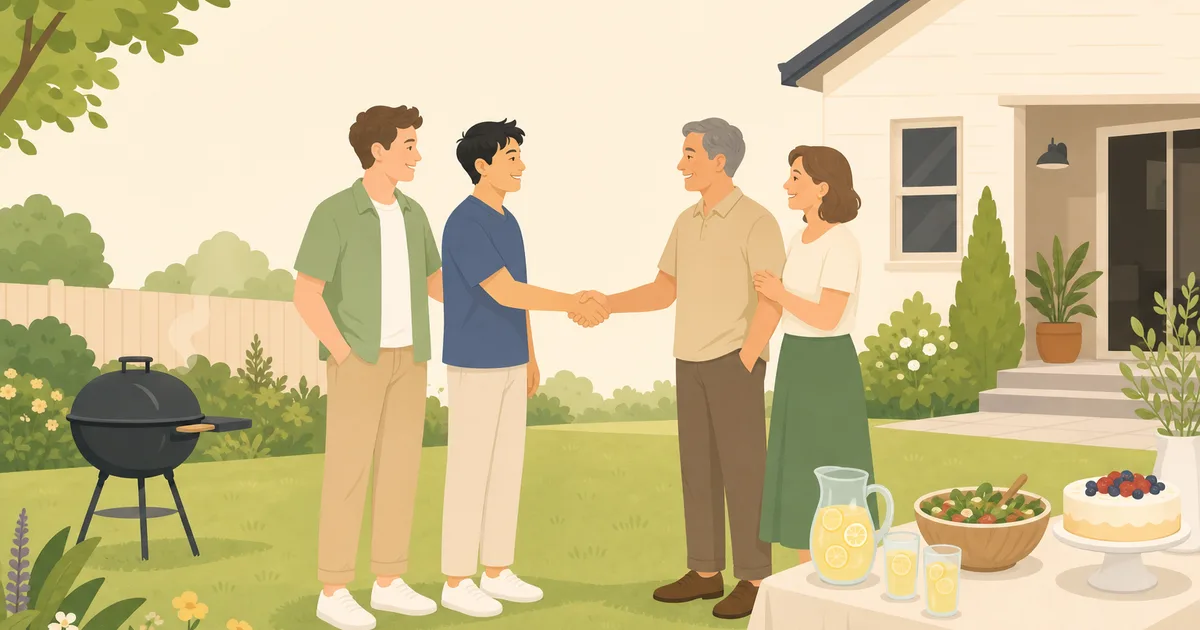
When your foreign partner meets your parents for the first time, you are the one doing most of the work. Your partner is nervous, your parents are curious and speak faster than they realise, and you sit in the middle as interpreter, cultural guide and mood reader at once. The good news: six or seven English phrases from your partner change the whole evening. Nobody will remember the accent. They will remember that your partner tried.
Below are thirty phrases to teach, how to prepare your parents and your partner, what to translate on the day and how, and a two-week plan for the two of you.
Key points
- Ten phrases said well are worth more than thirty half learned. Choose together the ones that suit your family.
- Your parents need preparing too: slower speech, one person at a time, and fewer idioms, jokes and sarcasm than usual.
- You translate intentions, not just words. English politeness is full of things that are not meant literally, and your partner needs a guide to them.
30 phrases to teach
Most learners know textbook English: Hello, how are you? I am fine, thank you. What they rarely learn is the soft, indirect English of a family dinner: could, would, I'd love to, bear with me. Teach these separately, and explain when each phrase fits; it sticks much faster. ○○ marks a name or a word to fill in.
Greetings
| Phrase | When | How to teach it |
|---|---|---|
| Hi, it's so nice to meet you. | At the door | With a smile and a handshake, or a hug if your parents are huggers |
| I'm ○○. | Straight after | Short and always right |
| Thank you so much for having me. | Coming in | The phrase parents appreciate most |
| ○○ has told me so much about you. | When you come up | It always gets a smile |
| What should I call you? | In the first minutes | Tell your parents to answer with first names if that is what they want |
| You have a lovely home. | In the living room | A compliment on the home always lands |
Polite forms and asking for help
| Phrase | When | How to teach it |
|---|---|---|
| I brought you a little something. | Handing over the gift | Explain that a modest gift is fine; an expensive one can embarrass |
| I'm still learning English, so please bear with me. | When the talk speeds up | Said early, it slows everyone down |
| Sorry, could you say that again? | When a sentence gets lost | Better than smiling and nodding |
| Could you speak a bit more slowly? | When it gets too fast | Practise the soft could, not a flat speak slowly |
| What does ○○ mean? | When an idiom flies past | Your parents become teachers and everyone relaxes |
| Can I give you a hand with anything? | In the kitchen | Explain that offering help is expected, even if it is turned down |
At the table
| Phrase | When | How to teach it |
|---|---|---|
| This looks amazing. | When the food arrives | A compliment before the first bite |
| This is delicious. Did you make it yourself? | After the first bite | Opens the story of the family recipe |
| Could I have the recipe? | To whoever cooked | The highest praise |
| Could you pass the ○○, please? | At the table | Explain that reaching across people is rude, asking is not |
| I'd love some more, thanks. | When offered seconds | Accept the first offer; there may not be a second |
| I'm full, but it was wonderful. | When they really cannot | A no plus a compliment |
| Cheers! | Raising a glass | And, in Britain, a casual thank you |
| Let me help with the dishes. | After the meal | Even if the answer is no, the offer counts |
Small talk
| Phrase | When | How to teach it |
|---|---|---|
| I'm from ○○. | When asked where they are from | A city opens more conversation than a country |
| I work in ○○. | When asked about work | Find the right word together |
| How long have you lived here? | When the conversation stalls | A question back keeps small talk going |
| We met in ○○. | When asked how you met | Rehearse the short version together |
| ○○ means a lot to me. | When the talk turns to the two of you | A short sentence with a big effect |
Thanks and goodbye
| Phrase | When | How to teach it |
|---|---|---|
| Thank you for a lovely evening. | Getting up to leave | Works for leftovers pressed into their hands too |
| We should probably get going. | To start the goodbye | Shows they know the rhythm of an evening |
| It was really nice to meet you both. | In the hallway | Rounds off the first visit |
| I hope we see each other again soon. | At the door | Your parents will remember it |
| Take care, bye! | Walking out | A thank-you message the next day is a bonus |
What to tell your parents beforehand
- How good your partner's English really is. "Speaks a bit" and "can hold a conversation" are different things. Honest expectations save disappointment on both sides.
- Slowly, one at a time. Family dinners are fast, overlapping and full of in-jokes; for a learner it is noise. Ask for a calmer conversation, at least for the first hour.
- Idioms, sarcasm and understatement. "Not bad at all" for a great meal, "we must do this again sometime" as a polite goodbye, gentle teasing as affection: all of it is confusing without context. Ask your parents to say what they mean, just this once.
- Offer twice. In many countries, from China and Vietnam to Iran and much of the Arab world, a guest refuses the first offer out of politeness and waits for the second or third. If your partner says no to dessert, ask your parents to offer again.
- Invite first names out loud. Many guests will keep saying Mr and Mrs, or will not know what to call your parents at all, until they are clearly told Please, call us Sue and Mike.
- Questions that sound personal. Your partner may ask your parents' age, what the house cost or what they earn. In some cultures that is friendly interest. Warn your parents, and warn your partner.
What to explain to your partner
- First names. Most English-speaking parents prefer them quickly. It is warmth, not a lack of respect.
- *How are you?* is a greeting. The answer is Good, thanks, and you?, not a health report.
- Please, thank you, sorry. Constantly, for small things. A direct request can sound like an order even when it is grammatically perfect.
- No means no. If they refuse something politely, it will probably not be offered again.
- Offering help. Clearing plates and offering to wash up are expected gestures, even if your parents refuse.
- Understatement and irony, especially in Britain. If your father calls the dinner "not too bad", he is proud of it.
On the day: what to translate and how
Do not try to translate everything, or you will spend the whole evening as an interpreter. Give priority to questions addressed to your partner and to emotional moments; summarise the rest.
- Irony, with context. "So you're the one who's taking our daughter away" needs a "he's joking" next to it.
- Understatement, as meaning. "It's nothing fancy" does not mean the meal is simple: your mother has been cooking since noon.
- Your partner's directness, softly. "I don't like this" can become "she's still getting used to it", which is not a lie.
- The rule. To your parents, translate your partner's heart; to your partner, your parents' intentions.
- You are in the conversation too. When your partner can answer alone, wait and let them.
Two weeks of practice together
- Days 1–3: the doorway. You play your parents: your partner greets, shakes hands or hugs, and introduces themselves, three times a day.
- Days 4–6: the table. At every meal, This looks amazing, This is delicious and Could you pass the ○○, please?
- Days 7–9: the questions. Ask the questions your parents are sure to ask, at full family speed, and your partner answers briefly.
- Days 10–12: the dress rehearsal. From the doorbell to We should probably get going, including the offer to help in the kitchen.
- Days 13–14: polish. Fix one sound per phrase, often th, r or a final consonant, and choose together the ten phrases your partner will use.
How LinguaPair helps you both
LinguaPair is made for couples like you two, who learn each other's languages. You invite your partner and your two accounts become a pair: your partner learns English and you learn their language, each in short lessons, with the A0 and A1 levels free, and each of you sees the other's level and streak. Games against each other, translation duels and vocabulary races, are built from your words, so you can compete with exactly the phrases above. On the day itself, the live translator works on one phone at the table: your parents and your partner each speak their own language and every line is translated as you go, so you can step out of the interpreter's role for a while and enjoy the evening. The words from those conversations land in the vocabulary trainer, material for the next visit. Games and unlimited translation come with Premium, and one subscription covers both of you.
If you are the one meeting their family, read how it works with German parents, French parents, Spanish-speaking parents, Italian parents, Brazilian parents, Russian parents, Korean parents, Japanese parents or Vietnamese parents. If a wedding is next, continue with a toast and vows in your partner's language, and for the first words of love, how to say I love you in 10 languages.